18
February
2025
Calculation of the sagitta (height of the arc) from the distance between two points on the circle
18:43

Calculation of the sagitta (height of the arc) from the distance between two points on the circle

18 February 2025 18:43

At distances greater than 10 km during VHF radio communications, the curvature of the Earth affects it. The article provides formulas for calculating the height of the “hill” between two antennas, which does not allow for direct visibility due to the sphericity of the Earth.

How is "sagitta" translated into Russian?

The sagittal plane is an imaginary plane that divides the body into two parts -right and left(used in anatomy)
Sagitta(Latin) - arrow.
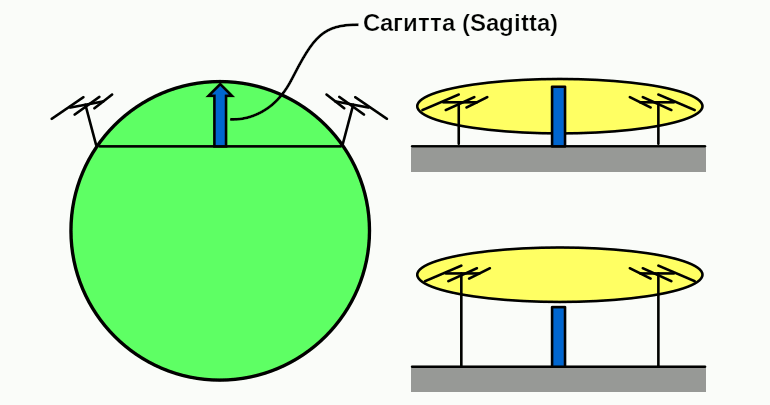
Sagitta- in geometry: a segment above the center of the chord.

Why does a radio amateur need to know sagitta

1) For radio communications over 10 km, the earth cannot be considered flat. A “hill” of earth or water occurs even on a completely flat surface, such as the sea between two points. The height of this mound ranges from 0 meters when two points are placed close together on the sphere to 1 radius of the Earth (6378 kilometers) when the points are maximally spaced around the circle. It is clear that you need to raise both antennas to at least the arc height, i.e. sagitta. In fact, even higher - depending on the radius of the Fresnel zone.
2) Programs for calculating the vertical profile of a route taking into account the relief usually do not take into account the curvature of the Earth. In the middle of the route, the height of the hill should be added to the height of the terrain.

Sagitta calculation

Method No. 1 (from Wikipedia)

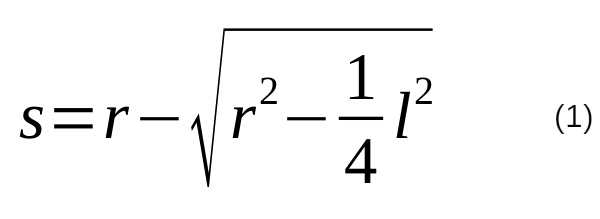
B Wikipedia is a formula that follows from the Pythagorean theorem, which involves the length of the chord (distance in a straight line) and the radius of the Earth. The formula does not take into account the distance between points on the Earth's surface, but along a straight line.

Sagitta - formula 1

where:
l - chord length (distance between points) in a straight line through the Earth.
r is the radius of the Earth, taken as 6378 km.

Calculation example:

  • chord length 40 km. Sagitta s= r - sqrt{ r^{2} - {1} over {4} l^{2} } = 6378 - sqrt(63782 - 0.25 * l2) = 0.03136 km = 31.36 m

Method No. 2

Source:calculator on Math Open Reference

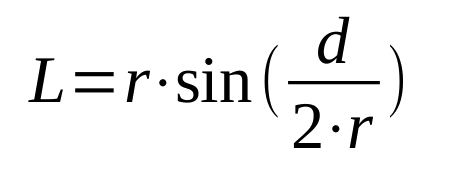
First, we find L - the length of half the base of the arc.

Length of half the base of the arc:

L

d - distance between currents in km,
r - radius of the earth 6378 km.

For example, for d=40 km
L = r cdot sin( {d} over { 2 cdot r } ) = 6378 * sin (40/6378/2) = 19.9999672229


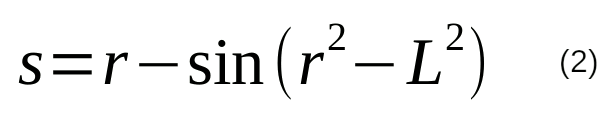
Step 2: substitute L into the formula.

Sagitta:

Formula No. 2 for calculating sagitta

For example:

s = r - sin( r^{2} - L^{2} ) = 6378 - sin (63782 - 19.99996722292) = 0.0313922203349648 km = 31.39 m

That is, both methods No. 1 and No. 2 use the chord at the base of the sagitta. (In the second method - half a chord).


Method No. 3 (simplified)

Works well at distances up to 1000 km simplified formula for calculating sagitta:
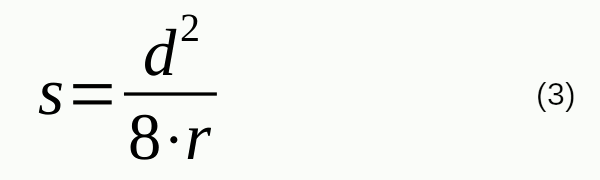
Simplified sagitta formula: s = d^2/8r

where:
d - distance between currents in km,
r - radius of the earth 6378 km.

For example:
s = {d^{2} } over { 8 cdot r } = 402 / 8 / 6378 = 1600 / 8 / 6378 = 0.03136 km = 31.36 m

  • s = {d^{2} } over { 8 cdot r } - LibreOffice Math notation.

Conclusion

The article presents three ways calculation of sagitta - the height of the mound of the earth's surface between two antennas.
For stable radio communication on VHF, it is necessary to raise both antennas to a height of s, plus the Fresnel zone radius.


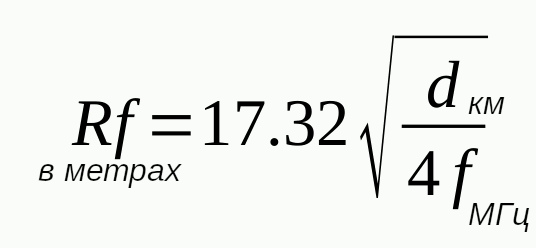
Fresnel zone radius in meters

rfren

where d is the distance in km, f is the frequency in MHz,
rf - in meters.

For example, for a distance of 40 km and a frequency of 145 MHz

Rf = 17.32 * sqrt (40 / 4 / 145) = 4.54 m.

Increasing the installation heights of the transmitting and receiving antennas by the radius of the Fresnel zone reduces losses during radio signal transmission, since the main path of the radio signal is more complete and the signal is not subject to reflections from obstacles.

Table of antenna heights depending on distance

Below is a table of sigitta and Fresnel zone for various distances between antennas.
Antenna heights are indicated in meters.

The last two columns show the required antenna height to ensure 100% VHF communication.
Since in amateur radio practice the use of masts higher than 10-20 meters is impossible, radio amateurs for long-distance communication on VHF carry out trips to nature - to the mountains. Maximum heights in the Leningrad region are about 100 - 170 meters. Thus, between two elevations or hills of about 120 meters in height, radio communications can be carried out in line of sight at a distance of 80 km. The height of the mast for 145 MHz is 6-7 meters, for 433 MHz - 4 meters, with a distance between correspondents of 80 kilometers.

d, km sagitta, m Fresnel 145 MHz, m Fresnel 433 MHz, m H,h 145 MHz, m H,h 433 MHz, m
1 0.02 0.72 0.42 0.74 0.44
2 0.08 1.02 0.59 1.10 0.67
3 0.18 1.25 0.72 1.42 0.90
4 0.31 1.44 0.83 1.75 1.15
5 0.49 1.61 0.93 2.10 1.42
6 0.71 1.76 1.02 2.47 1.73
7 0.96 1.90 1.10 2.86 2.06
8 1.26 2.03 1.18 3.29 2.43
9 1.59 2.16 1.25 3.75 2.84
10 1.96 2.27 1.32 4.24 3.28
15 4.41 2.79 1.61 7.20 6.03
20 7.85 3.22 1.86 11.06 9.71
25 12.26 3.60 2.08 15.86 14.34
30 17.66 3.94 2.28 21.60 19.94
35 24.03 4.25 2.46 28.29 26.50
40 31.39 4.55 2.63 35.94 34.02
50 49.05 5.09 2.94 54.14 51.99
60 70.63 5.57 3.22 76.20 73.86
70 96.14 6.02 3.48 102.16 99.62
80 125.57 6.43 3.72 132.00 129.29
90 158.92 6.82 3.95 165.75 162.87
100 196.20 7.19 4.16 203.39 200.36
110 237.40 7.54 4.36 244.95 241.77
120 282.53 7.88 4.56 290.41 287.09
130 331.58 8.20 4.75 339.78 336.32
140 384.55 8.51 4.92 393.06 389.48
150 441.45 8.81 5.10 450.26 446.55
160 502.27 9.10 5.26 511.37 507.53
170 567.01 9.38 5.43 576.39 572.44
180 635.68 9.65 5.58 645.33 641.27
190 708.27 9.91 5.74 718.19 714.01
200 784.79 10.17 5.89 794.96 790.68
250 1226.22 11.37 6.58 1237.59 1232.80
300 1765.73 12.46 7.21 1778.19 1772.94
350 2403.32 13.45 7.79 2416.77 2411.10
400 3138.97 14.38 8.32 3153.35 3147.29
450 3972.67 15.26 8.83 3987.92 3981.50
500 4904.41 16.08 9.31 4920.49 4913.72

Checking the calculation using the line of sight range formula

Line of sight formula:

S = 3.57 * (sqrt(H) + sqrt(h))

Formula for radio communication range taking into account the refraction of VHF radio waves:

S = 4.12 * (sqrt(H) + sqrt(h))

See Javascript online VHF radio range calculator on the website http://kavkaz.qrz.ru/.

  • at height H, h =2 meters range according to the formula: 8-12 kilometers (my calculation is 5 km)
  • at height H, h =6 meters range according to the formula: 15-20 kilometers (my calculation 15 km)
  • at height H, h =10 meters range according to the formula: 19-26 kilometers (my calculation 20 km)
  • at height H, h =20 meters range according to the formula: 27-37 kilometers (my calculation 30 km)

    Conclusion: formulas 3.57 and 4.12 above overestimate the range when the antenna installation height is 2 meters (at the level of the pedestrian’s head), because do not take into account the required radius of the Fresnel zone (1.5-2m) above the obstacle. The calculation using the sigmat and the radius of the Fresnel zone is more accurate - the range of stable radio communication when using portable radio stations will be 5 km, and 8-12 km. Moreover, at low altitudes when installing antennas, the range is significantly influenced by terrain.


Last change: 02.19.2025.