12
May
2020
Attenuator for sound card
10:44

Attenuator for sound card

12 May 2020 10:44

When combining the operation of digital types of radio communications, you need:

  • First, to coordinate the signal levels between the two devices,
  • Secondly - maintain the signal level within certain limits (regulation of the output level).

This article is devoted to a home -made attenuer to weaken the sound signal for digital species.

When I work with digital species (on 14.1 and 10.1 MHz mainly) the problem is a high level of signal from the external USB sound card. Since my CAT interface is homemade, the sound to the transmission passes through a dividing transformer (galvanic denouement) 1 to 1 without any weakening, there is no level regulators.
It is necessary to reduce the volume to zero in the computer.

I studied the question. It turned out that the output of ordinary sound cards produces a voltage of 1 volt (it will be more accurately measured later, the article will be added), while the entrance for the absence of overload is designed for a voltage of 0.3 volts (see below).

The class of devices "Attanoists" are important both in professional sound technique and among radio amateurs, and even in the microwave technique.

In this case, we have a non -enable, that is, an asymmetric output of the sound card (signal and "earth"), and the same asymmetric entrance to the transceiver. As a circuit, the simplest voltage divider for 2 resistors chose.

Since the sound frequency generator has its internal resistance, the attenuator should in no case load it with a lower resistance than the internal one. In the maximum case (a short circuit of the output of the sound card), burnout of the output transistor will occur **. Even the equality of R generator and R attenuator is undesirable, because leads to overload and frequency distortions of sound.

Therefore, the inlet resistance of the attenuator of the attenuator should be 2-3 orders of the generator, so as not to affect it. The exact resistance of the linear output of the sound card according to publicly available data is about 600 ohms.

If the output resistance of the line output (not headphones) is taken 600 Ohms, then the input resistance of the attenuator should be higher than 600 ohms by 100 ... 10,000 times more than 60 kOhm. That is, the total resistance of the resistors R1, R2 should be 60-100 kOhm.

On the response side - at the input of the transceiver or other sound input device high -resistance entrance (50 kOhm). According to data Wikipedia в бытовой аппаратуре используется стандарт -10 dbV или 0.316 Вольт. Однако, обычный линейный выход обеспечивает напряжение до 1 Вольт.

Purpose : Calculate the attenuator with such weakening voltage so that at the voltage at the entrance of 1 volt at the output, a voltage of slightly less than 316 mV is obtained (expressed in decibels, the change in the ACPLITAL voltage by 20*log10 (316/1000) = -10 db. At the same time, I take the input resistance of the attenuator equal to 50-60 kom.

The output voltage of the voltage divider is calculated by the formula

V weekend = v input * z2 / (z1+z2)

Various combinations Z1 and Z2 are given in the table:

Z1 Z2 V weekend, in
30k 30k 0.5
50k 50k 0.5
30k 20k 0.4
33k 20k 0.377
50k 30k 0.375
40k 20k 0.333
47k 22K 0.318
43k 20k 0.317
47k 20k 0.299
50k 20k 0.286
43k 10k 0.188
50k 10k 0.166
50k 5k 0.09

As can be seen from the table, the face value of the resistors to weaken to the desired level are equal:
z1 = 43 kom and z2 = 20 kOhm or z1 = 47 kOhm and z2 = 22 kOhm .
The 47 and 22 rooms available in the store (ordered, the article will be supplemented).

By the output of the sound_ from the transceiver to the input "line in" of the computer is the same, but in the opposite direction. That is, a set of 2 attenuers will be required.

Sources:

https://cxem.net/calc/divider_calc.php - схема аттенюатора, расчет выходного напряжения

http://wwww.sengpielaudio.com/calculator-db-volt.htm - перевод напряжения Вольт в dbu и dbv

На The screensaver used the RFSIMM99 graphics.
https://cxem.net/software/rfsim99.php


Result

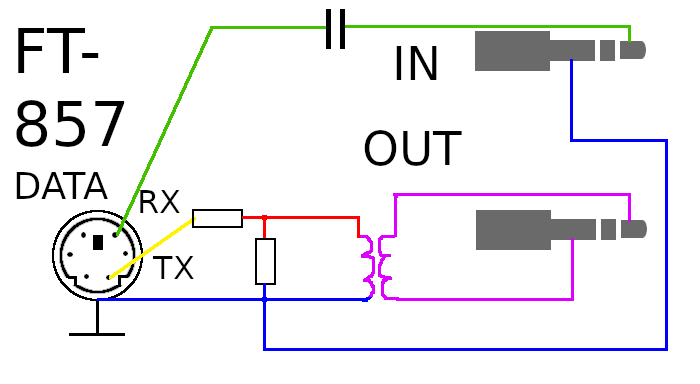
It turned out such a scheme (I modified the CAT interface with my own hands).
CAT interface FT-857
The colors correspond to the flowers of the wires of the ps/2 wires, from which the connector was cut off.
To the circuit, only divided the voltages in the transmission.
Previously, Dig Gain (menu item 037) stood at 01, now on 05, which allows you to smoothly adjust the integration of Dig Gain within 1-7.
The entrance chain was not subjected to changes.

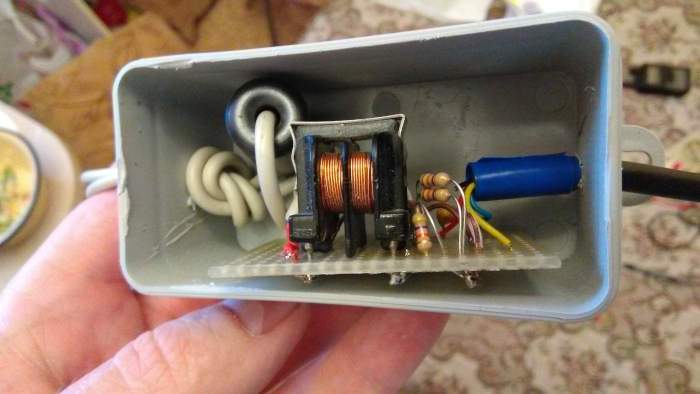
However, the 22 kOhm resistor had to be replaced with 2 pieces of 47 kOhm, turned on in parallel, because In the store, instead of 22 kOhm, resistors 22 Ohms were mistakenly put. ;-)
photo
I successfully conduct radio communications in FT-8 at this interface at a frequency of 144.147 MHz and on short waves of 10 and 14 MHz.
There is no plugging of the transmission at a power of 20 watts.

Answers to questions:
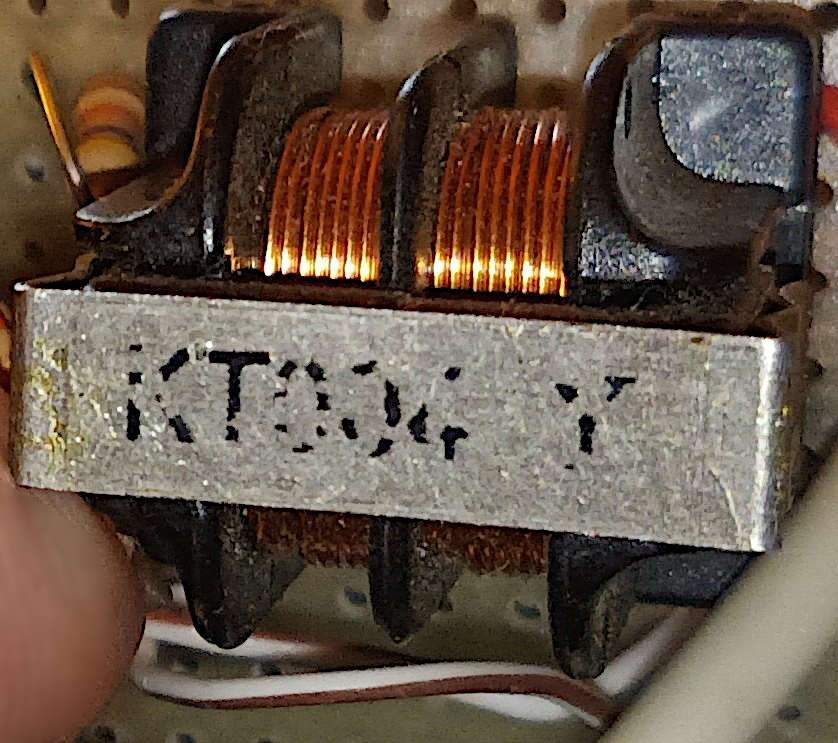
Question: transformer data?
OTUT: measured inductance of the winding 1 - 3.5 mg, 2 - 3.7 mn. The inscription on the transformer erased: KT -004 -y.
The resistance of the winding is ~ 150 Ohm. I have no necessary data and information about the material of the magnetic circuit.
The transformer from the "voice" modem US Robotics is suitable.

Transformer

Update from 02.10.2022:
Sound frequencies for galvanic interchange are sold in bulk of 10 pieces on aliexpress:
Audio transformers 600 Ohms 1: 1 insulation

Insulating transformers 1 to 1 look like this:
Transformers1to1


Related publications