3
August
2021
APRS cables for Baofeng UV-5R: two options
0:56

APRS cables for Baofeng UV-5R: two options

3 August 2021 0:56

How to make a cable for APRS.

APRS was intended for use in off-grid environments—for example, when cellular service is down or unavailable.
The APRS standard is also quite open, and has not changed for many years - APSK modulation without encryption, which allows you to “read” messages even without special software, simply by observing the receiving window of the amateur radio standard PACKET decoder in MixW or HamRadioDeluxe, or even Soundmodem by UZ7HO.

To transmit information, you need one or another computing platform - a smartphone, PC or laptop (netbook). There is a good program for Android -APRSdroid, for Windows PC - UI-View, APRSISCE/32, for Linux - program Xastir.

My understanding of the prospects for APRS. Advantages and Disadvantages

Conditions for the development of technology are good, but in recent years the interest of radio amateurs in APRS has begun to fade. Why? Ready-made radio stations D-Star, Website and forum www.dstar.su was launched in June 2012. D-Star radio stations had two standards (digital and analogue), they were also able to transmit APRS packets, the need for TNC controllers and KISS modems disappeared.

The disadvantage of solutions based on D-Star is that they are compatible with digital modulation only with themselves, with their own standard. Accordingly, radio amateurs were forced to play with an expensive toy and “dump” it on the market while the transceiver could still be sold.

This was followed by a cheaper option - DMR, but in it the processing of APRS packets occurs at the “core” level of the Brandmeister network, and not at the local node level, as in APRS. To numerous requests from users to include APRS decoding in the DMR/D-Star node, the answer from the developers is that they don’t even have such plans. DMR users have no choice: their packets go to the APRS network only through Brandmeister's main DMR network. The technology was not autonomous, not adapted to work in conditions, for example, of the complete absence of the Internet. Also, different radio stations “speak different languages” when transmitting GPS coordinates, and to translate packets to the APRS standard, there are servers abroad that process incoming traffic. Thus, DMR is the most Internet-connected amateur radio technology.

What is the reason for the increased interest in APRS?

Watching foreign sites, and only there, I noted surge of interest in classic APRS, for the following reasons:

  1. Previously, APRS controllers (KISS/TNC modems) were similar to old modems - large and iron. Recently, private companies have started producing “plug and play” TNC/KISS controllers, slightly larger than a matchbox, which, using adapters for the headset jack, turn any cheap analog radio station into an APRS node. Radio amateurs often establish communication with a smartphone running the APRSdroid program wirelessly - using Bluetooth, which is convenient. The price of the kit excluding the smartphone is more than affordable - from 100 to 135 dollars. The controller can be carried along with the radio station - taken on hikes or trips, transmitting its coordinates on a generally accepted frequency. There is good support for similar devices on Youtube, which shows their setup and use.
  2. the proliferation of inexpensive, accessible radios like the Baofeng UV-5r, seemingly tailor-made for APRS-based solutions. They have built-in VOX.
  3. resumption of transmissions from the International Space Station (ISS) - APRS packets on a frequency of 145.825 MHz.
    1. Abroad, there is great interest in a healthy lifestyle (which is noticeably growing in our country): simple but exotic hobbies for us are common, such as trekking ("Nordic walking") along a pre-known route, hiking (amateur hiking on low mountains), cycling (road, family or group cycling tourism) and trail riding (extreme cross-country cycling races). Where portable radios are frequently used, radio amateurs may try turning on APRS to inform comrades of their progress along the route. The concentration of radio amateurs, for example, in a national park, can lead to a “transition from quantity to quality” - the appearance of moving marks on the map aprs.fi.
  4. generational change - the arrival of a new wave of people aged 16-25 years old, who will be interested in radio, APRS and the same ISS.

In our country, Russia, for a number of reasons (certain difficulties with ordering equipment from abroad - the same language barrier, the impact of currency fluctuations on the price, problems with logistics), the option of purchasing a modern TNC controller for APRS cannot become widespread.
Self-assembly of controllers like KPC-3 on PIC controllers is available to select craftsmen with “golden” hands.

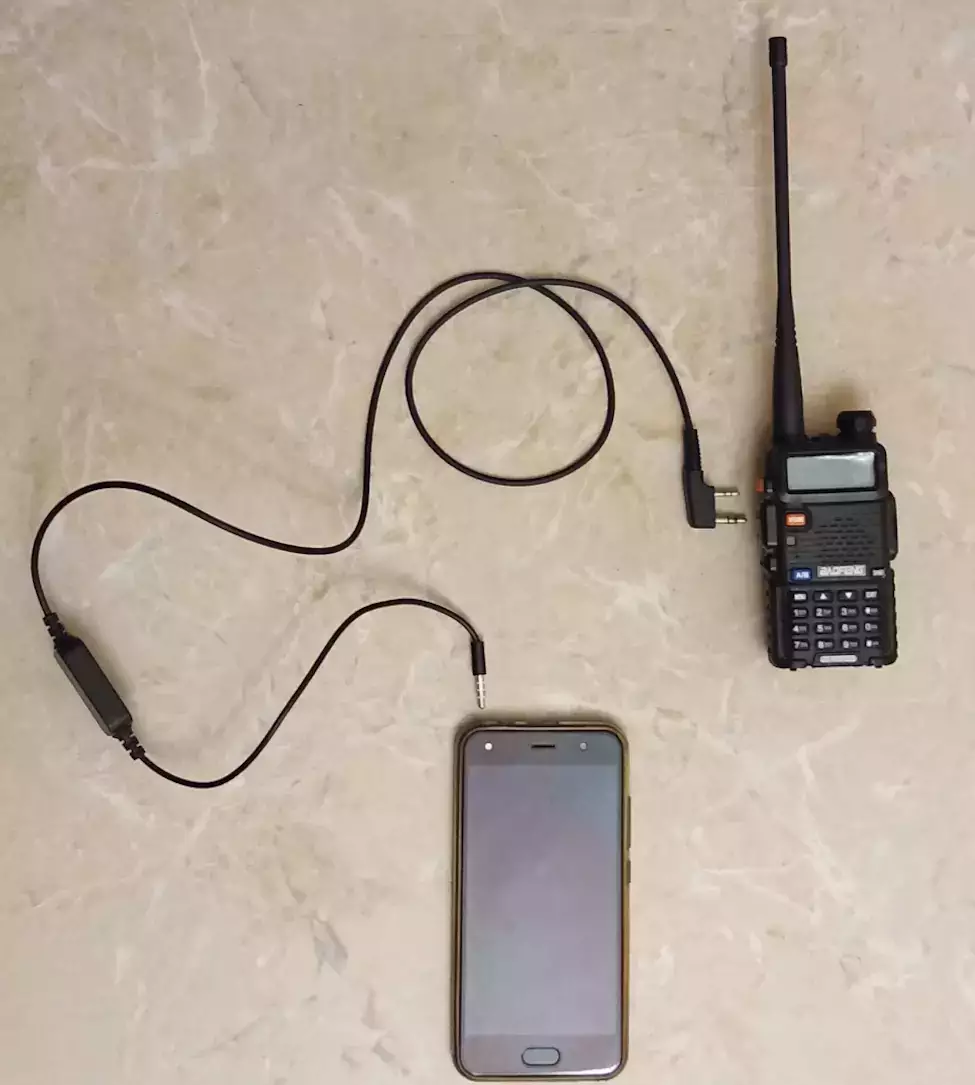
There remains the prospect of using portable radios with various cables and adapters for connecting to a smartphone. Many of which can be bought on Ozon, AliExpress, or in computer stores. Below are photographs of two working cable options for APRS, which have been tested for reception and transmission. The formation of AFSK sound for transmission is carried out by a smartphone (which outputs sound to the headphone/headset jack), and the transmission itself is carried out by a radio station with the VOX (voice activated transmission) function. Receiving APRS traffic from the air: processing of the sound received by the radio station is taken over by the APRSdroid program (sound input from the same 4-pin headphone/headphone jack). The sound recording level must be set using the volume control - the knob on the radio station and secure the control in the maximum position with a rubber band for banknotes purchased at an office supply store.

To set up the system, it is advisable to have two radio stations to monitor the presence of sound / modulation when transmitting APRS packets.

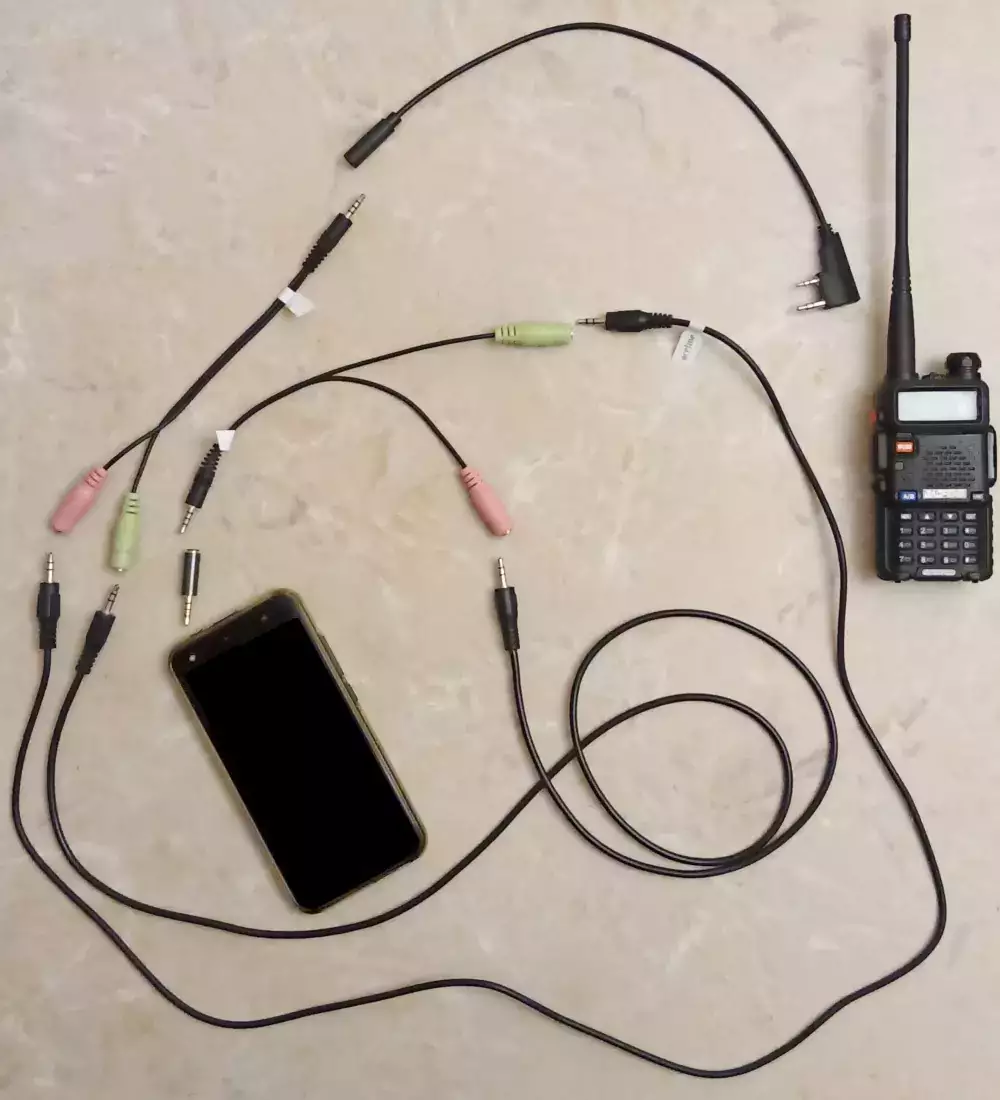
The first cable option for a smartphone using "jack 4pin" adapters - for 2 pcs. "jack 3 pin"

The sound output of the radio station is fed to the microphone input of the smartphone, and the sound output of the smartphone is fed to the sound input of the radio station. An adapter was used from the Baofeng/Kenwood radio connector to the iPhone headset.

  1. Baofeng/Kenwood cable manufacturer Retevis, cable model TCK01, price about 500-550 rubles from AliExpress. - 1 pc.
    Cable from RETEVIS, model TCK01 the remaining components of the cable were purchased at the nearest computer store:
  2. 2.Adapter 4-pin mini jack 3.5 mm (M) - 2 x mini jack 3.5 mm (F)- 2 pcs.
  3. 3.Audio extension cable jack 3.5 (M) - jack 3.5 (M)- 2 pcs.

The surmountable disadvantage of this solution is the presence of a constant voltage to power the electret microphone, which the radio station perceives as an input signal. As a result, when the audio transmission of an APRS packet is completed, the radio remains on high frequency transmission. That is, the transmitter is working, and you have to turn it off manually by rotating the volume knob. I took the coupling capacitor for the homemade cable from the second solution. Such a separating capacitor, in the absence of an insulating adapter, could be independently soldered “into the cut” of the wire responsible for outputting sound from the smartphone to the input of the radio station..

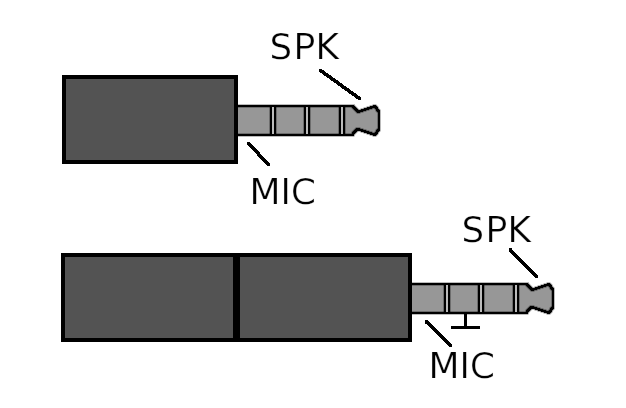
Addition from 03/2024 the problem of transmission sticking, in my opinion, is due to the lack of ground. The TRRS adapter to 3-pin shifts the middle contact, ground appears and the radio station, with VOX turned on (level 1), ends transmission if there is no signal. Thanks to RM1M for pointing out the error!
See picture below.
trrs
A 4-pin TRRS 4pin to 3pin adapter is enough
You can buy it on Yandex.
Adapter adapter for microphone from mini jack 3.5 mm TRS to TRRS connector (from 3 pin to 4 pin)

The transmission sticking has stopped.

The sound level on the smartphone and homemade cable should be reduced by two single clicks to avoid overloading the radio station input. Also, set the volume on the radio station itself to 20-30%, because... there is no divisor here.

RUB 516.11 18% DISCOUNT | Retevis TCK01 for Kenwood 2Pin to 3.5mm Female Phone Audio Earphone Transfer Cable for Retevis RT21 RT22 RT24 RT27 H777 C9061A
https://a.aliexpress.com/_AKKp42

The second option is a ready-made cable from AliExpress (issue price is about 2000 rubles)

Cable brand APRS-k1. No comments required.

Let me add that the signal level for transmission with the APRS-K1 cable is slightly lower (it does not have to be reduced by adjusting the volume of the smartphone), because The manufacturer has implemented a several dB attenuator inside the “box” to prevent overloading of the radio station input. The same divider is implemented for reception (setting the maximum volume on the radio station corresponds to the optimal level for recording sound or decoding on a smartphone).
2nd

RUB 1,655.92 45% DISCOUNT | APRS-k1 Audio Interface Cable for BaoFeng UV5R UV-82 5RA 5RB 'd xun TYT (APRSpro, APRSDroid, Compatible - Android, iOS
https://a.aliexpress.com/_AWlUB4

Addition from 03/2024:

APRS-k1 device

Photo:
apr-k1-bottom
(The manufacturer painted over the element values with a permanent marker).
The reverse side of the board - one element is installed: resistor red-red-red-gold = 2.2 kOhm.
apr-k1-top
The following photo shows the names of the elements: R6 C3 R5 R4 C4 / C1 R1 R2 C2. The last element P1 is not installed.
aprs-k1

Connection diagram of the APRS-k1 adapter to the Baofeng radio station and smartphone

sheme-aprs-k1
If the radio station is on the left - wire colors from top to bottom:

  • MIC - red
  • GND - blue
  • sp - black
    Smartphone on the right:
  • sp - blue
  • GND - red
  • MIC - orange (golden)

Checking the work and conclusions

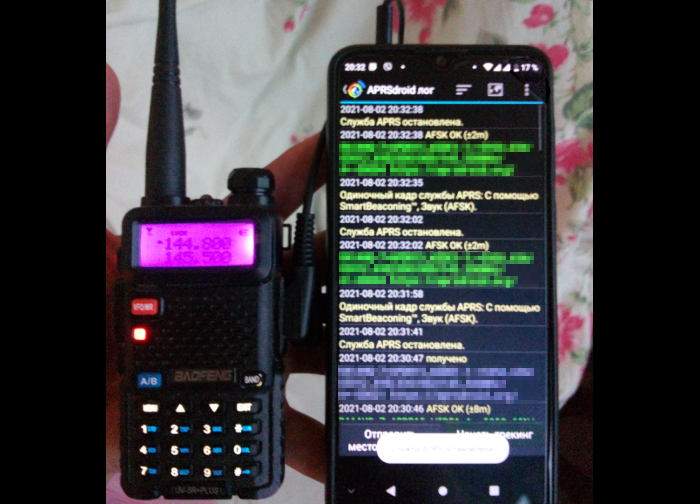
Cable testing was carried out by a control "fixed" APRS radio RA1AHQ-1 (which ran DireWolf and XASTIR), while the handheld Baofeng UV-5r had SSID -5 (in APRSdroid). The minimum power for transmission on the portable station was set to 100 mW in order to prevent packets from leaving the APRS gate. Frequency - 144.800 MHz.

At first, decoding did not work at the control radio station, even though the volume of the packets being transmitted was good.

The reason turned out to be trivial: it is necessary to increase the duration of the “preamble” so that the radio station’s VOX has time to operate before the main part of the packet is transmitted: a preamble duration of 200 ms is small (no decoding), and a preamble duration of 1000 ms is long, it can be reduced.

Both cable options work well.

Conclusion:

This implementation of the APRS tracker has the right to life.


Related publications