
11
May
2020
APRS via satellites and KV (theory and practice)
15:17

APRS via satellites and KV (theory and practice)

11 May 2020 15:17

I want to collect on this page all the information about the use for the transfer of the Repiter APRS packages on board the ISS (International Space Station) and other working satellites (PSAT).

Introduction

On board the International Space Station, a radio station kenwood d710, working with the call sign rs0iss , was installed.
It works on board the ISS in the automatic mode of the APRS digital relay. Modulation - AFSK 1200 BPS, frequency 145.825 MHz. If the ISS is in direct visibility , the amateur radio can transfer the APRS package on board the ISS, which other radio amateurs can answer. The connection is counted if the package was retraped through the ISS board - a symbol * is added to the APRS message - a sign of relay.

Orbits of the ISS

The calculation of the time of future orbits for your settlement can be performed in Linux in the program gpredict
Or on the site https://www.amsat.org/track/index.php.

For work, I use XASTIR + SOUNDMODEM programs, as written in the previous article. Compared to the ground APRS 144.800, the changes in the settings are as follows.

XASTIR Settings for APRS via ISS

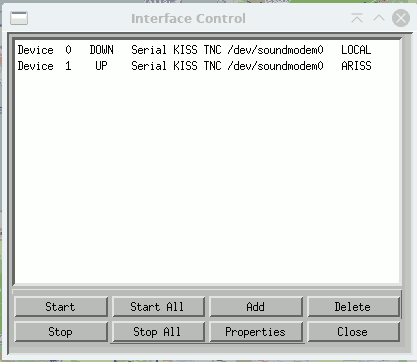
To work through the ISS in XASTIR in the Interface menu, you need to add a second interface - a copy of previously configured for 144.8.

Interfaces )

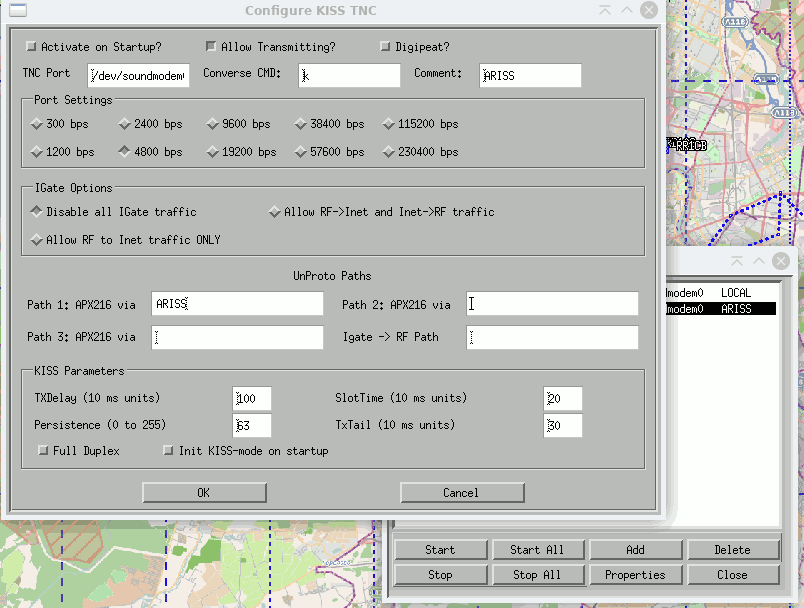
In the second interface (which is turned on during the ISS span), you need to edit the fields:
*The first field "Way" replace the usual value of Wide 2-2 with ariss .

  • In the comments, indicate ariss (note for yourself that the interface is for the ISS).
    Detailed interface settings )
    comments :
    1. The path may contain two values, for example, ariss, psat , but the packet retransaver on the ISS uses only the first value - i.e. Ariss. The longer the path, the more long transmission, so it is better to reduce the path to the shortest possible.
    2. In my opinion, data from the QRZ.com forums, ISS will not answer if it is indicated "rs0iss" or - this erroneous value does not work. It is also pointless to add the word APRS ahead, for example, APRS, ARISS - extra characters cllate the line of the track and do not improve the work.

The ISS Repiter himself will substitute his call sign RS0iss and an asterisk (*) into a retrained message of the cosmos-earth. The "Asterisk" symbol means that the package was accepted and retranked from the ISS.

You need to enter your call sign and square into the message itself. For example, like this: "Frank, FM19SX".

The frequency of the APRS RETRARESS ISS - 145.825 (reserve 437.550 MHz is not used at this time).

Package radio communications procedure through the ISS

Messages for the ISS are divided into groups:

  1. GPS coordinates via APRS. ("Gps lighthouses") without specifying the addressee. Open.
  2. Text APRS CONTACTIONS for QSO. Such as directed challenges to: call . - recommended .
  3. Not APRS message - for example, a regular Packet sent from the terminal, for example, BBS ( not recommended)
  4. Office APRS messages (direct request of the station) - not recommended. Examples of such messages:? APRST? Igate

The simplest thing is to transmit its coordinates at the time of the ISS flight ( Interface - Transmit Now! ) GPS coordinate positions - they will be repeated through the ISS and will be displayed on the map of other radio amateurs.

More correctly - call by transmitting messages as written below:

Rules for QSO using APRS messages

General challenge

Messages to everyone: in the field call specify the text text cq .
Call-CQ

Or specify a specific call sign ( directed call ) in the Call field, for example, RZ1PVT.
Direct

The text of the message is arbitrary. You can specify a square or QTH and name, ko59, op. Vladimir ..

The answer to the call

In the Call field, indicate the call sign of the correspondent, in the message field (text) - any response with a length of up to 40 characters in English. It should be noted that the longer the message, the higher the probability of errors when it is decoded due to a weak level or QSB (signs of signal).

Examples of short response messages:
Hello from SPB
**
TNX 59 73 GL **
73 de Call, Cu **

The callsigns to the official fields from FROM and To, as well as the coordinates of the station are affixed to the XASTIR and SoundModem program to the APRS package automatically.

Checking the relay of packages

The packages relayed back should be perceived by the receiver and decoded by the program. As with the usual digital relay, after your package the noise should follow - the response of the space station. Then your package with an asterisk will appear which means that it was retracked by the station to the ground.

Captured ISS (ISS) packages can be checked on sites:
http://www.ariss.net/
http://www.findu.com/cgi-bin/ariss/index.cgi

Casting for the ISS

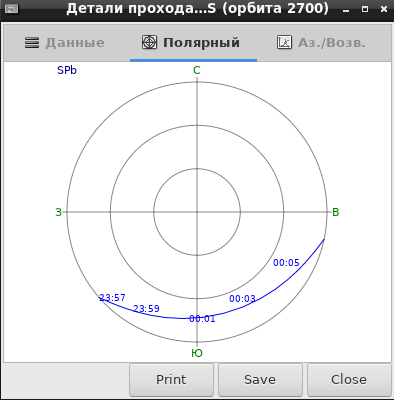
The trajectory of the ISS movement along the sky depends mainly on geographical latitude

LO53AC KO59CT

Since the city of St. Petersburg is 60 degrees of northern latitude, the height of the ISS above the horizon does not have higher than 23 degrees, the work with the ISS at the range 1100 ... 2200 km, while in the south of the ISS at the passage is at a distance of 435 ... 2200 km.

Moments of the station passage (UTC time) can be determined by Qth locomotor
*https://www.amsat.org/track/index.php

Calculation of the energy budget of the track

This calculation is not needed if it turns out to work with simple antennas and both sides go bags.
In my case, unexpected difficulties turned out - the ISS does not hear and is poorly heard, despite the fact that KSV = 1.1.

(Calculation when reinforced by the transmitter (Yaga antenna 3 elements) g = 7 dBI, from the receiver G = 0 DBI):

Losses in free space 600 km 1800 km 2200 km
124 db 134 db 136 db
the power obtained on the reception side 600 km 1800 km 2200 km
-80 dbm -90 dbm -92 DBM

The average signal power on the receiving side of -90 DBM.

S-meter readings on the reception side 600 km 1800 km 2200 km
S9+10 S9 S9

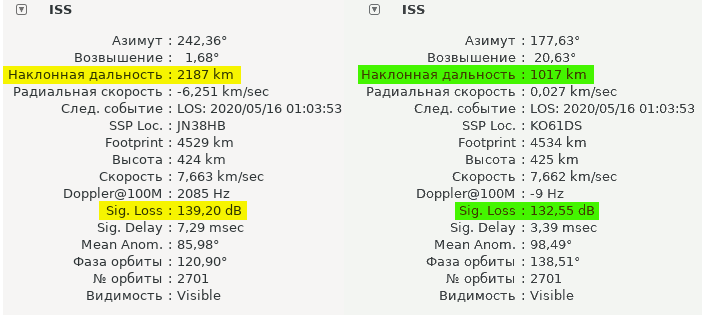
Called GPREDICT Loss weakening (Path Loss) - from 139 to 132 dB are included in the same range (134 ... 136DB average value).
losses

The S -meter readings (at a 10 W transmitter power) should be S9 (which was noticed at a different frequency - 145.800 voice relay, television departments with schoolchildren). But this is not observed.

Conclusion : 3 elements of Uda Yaga should be enough for communication with the ISS (ariss, rs0iss) "from horizon to horizon."

The same calculation for the pin Ground Plane 145.82 MHz (strengthening is worse than yaga at 5db. Losses in the cable another 2 dB)
It is enough to subtract from the previously obtained results of 7 dB. It turns out

600 km 1800 km 2200 km
131 db 141 db 143 db
-96 dbm -106 DBM -108 DBM
S8 S7 S7

Thus, the ISS-Earth Link in theory should also work on the usual GP pin, a power of 10 watts with a level of S8, i.e. Pretty loud.
In practice, this does not happen in 2020. Either the antenna on the ISS "Dumb", or an increased threshold of the sensitivity of the receiver, or reduced the power of the package APRS radio station?

Practical measurements of the level of packet communication of the ISS on 2 and 5 elements of Uda Yaga.

  • Vertical polarization - S4 ... S6.
  • Horizontal polarization - S4 ... S6.
    In vertical polarization, I heard a little louder, on the floor of the point.
    There is no question of any levels of the S9 with the ISS in 2020!

The reasons for the failure of work through the ISS, in my opinion:

  1. сигнал слишком слаб. Неподходящая мощность и антенны для данного бюджета линка, Напряженность поля быстро убывает с удалением до космической станции (в квадрате расстояния).
  • The most powerful ISS signal (ISS) - when passing through zenith. You can use the antenna directed up - for example, a horizontal dipole, Uda -Yagi 2 elements or a turnstile antenna.
  • At the height of the space station from 90 to 60 degrees over the horizon according to reports from the Internet, it is possible to transmit GPS coordinates from portable radio stations to standard "rubber" antennas, with a low capacity of 5W. For example, on Yaesu FT-2DR/DE, Kenwood Th-D74 with built-in APRS GPS Tracker.
  • At height above the horizon from 60 to 30 degrees, at medium distances, you need to add 10 dB to increase the pin-3-5 elemental antennas (G = 8-12 dBI) of fixed (45 °) or variable elevation are suitable. The required power is the same 10 watts.
  • At a height of 30 to 10 degrees, the ISS begins due to the distance, begins to hear your signal worse, you need to add another 2 dB for the program. For example, increase power by 2-3 times to 20 ... 30 watts. For intake, a low -soured amplifier (mush) with a noise coefficient NF = 0.5 DB is very desirable. Antenna - 6-8 elements.
  • At the height of the ISS from 10 to 0 degrees - local obstacles (multi -storey buildings) can interfere. We need a suburban position with the appearance of the horizon from west to east.

    1. некорректная настройка поля PATH (формирует путь UNPROTO) - необходимо указывать только ARISS или RS0ISS. Всевозможные WIDE2-2, RELAY, ~~SGATE - ошибочные значения.
    2. широкая модуляция вместо узкой. Не настроена девиация частоты. Важно тщательно подобрать ширину модуляции AFSK постепенно уменьшая громкость на компьютере до тех пор, пока сигнал не станет высокочастотным и звонким на слух. На WebSDR можно наблюдать при этом, что сигнал состоит из множества тонких линий, то есть чёткий, а не размазанный. Местный ретранслятор должен отвечать на посылки с первого раза.
    3. слишком длинное сообщение декодировалось с ошибками.
    4. не выполнена коррекция доплеровского сдвига частоты на передаче (хотя отклонение частоты от 145.825 небольшое +2кГц в начале и -2кГц в конце, возможно ухудшение связи в начале и конце витка из-за эффекта Доплера).
    5. Потери в кабелях на передающей и приёмной стороне без использования МШУ (LNA) приводят к ухудшению приёма.
    6. Сложная ситуация с помехами на южной стороне дома, в месте установки наземной станции для приёма МКС (перегрузка приемника от внеполосных излучений, нехватка динамического диапазона, эффект снижения чувствительности приёмника).
    7. Несбалансированный сигнал APRS по нижнему тону 1200 Гц и верхнему 2200 Гц - неравномерность АЧХ. Например, нехватка или избыток высоких частот.

    Links:

  • Modeling Link, planning of the budget of radio communications:
  • Calculation of losses (DB) when distributed in outer space -https://www.pasternack.com/t-calculator-fspl.aspx
  • Link budget calculation - see https://www.pasternack.com/t-calculator-link-budget.aspx
  • Transfer of DBM reception power into divisions of the S -UNIT reception scale -https://www.giangrandi.org/electronics/radio/smeter.shtml

Practice

On the directed antenna 3 of the elements of Uda -Yagi, the signal with a satellite above the horizon is a height of 5-10 degrees is S4 (the polarization is vertical or horizontal - it does not play a role), for 5 elements - not higher than S6.
The level of S -meter 4 points corresponds to the power of –123 DBM, although in theory the ISS should be heard in such conditions at -108 DBM even on the "pin" GP. On the same antenna, a short yagi 144/433 MHz, I hear the satellites of the XW-2B and XW-2C up to 5 points in the S-meter. The XW-2B capacity is 20DBM (decibel-millivatt-DBM) or 100 MW in the Ground Plane antenna. The capacity of the APRS radio station at the ISS at 145.825 was, judging by audibility, even less than the XW-2B. Less than 0.1 watts. The reception is similar - perhaps on board the ISS use a 15-20 dB attenuator? The same is confirmed by the photo from the Telegram channel of the ISS, from the photo "on the table before sending Kenwood APRS" APRS. But these are only my guesses, the power of 145.825 MHz actual in 2020, no one voiced.


Other APRS satellites

Satellite No -44 - does not work.

Satellite psat - APRS APRS map psat ( no -84 ) at a frequency of 145.825 MHz,
the height above the horizon in St. Petersburg - up to 10 degrees (flies in the southern latitudes and above the equator).

APRS: On the way UNPROTO use the PCSAT text. You can try the text ARISS, PCSAT.
The power of the transmitter PSAT is only 300 MW.
In case of loss in free space 130 ... 140 dB and the indicated power, field strength at the reception site is -100 ...- 110 dBM or about S7 points.

Sources:


Links to articles and APRS forums through ISS:

  • [http://www.aprs.org/ariss.html.(http://www.aprs.org/ariss.html) - introductory.
  • https://amsat-uk.org/beginners/how-to-mo-the-on-oprs-packet-radio/ - Guide for the beginning 7.
  • https://www.amsat.org/wordpress/wp-content/uploads/2014/01/amsat_journal_iss_packet.pdf - Article from AMSAT magazine.
  • [https://www.fars.k6ya.org/docs/aprs_via_iss.pdf.(https://www.fars.k6ya.org/docs/aprs_via_iss.pdf) - APRS via ISS
  • [http://forum.vhfdx.ru/sputniki/aprs-cherez-mks-i-sputniki/0 Resesshttp://forum.vhfdx.ru/sputniki/aprs-cherez-i-sputniki/)-APRS-APRS-APRS Through satellites.
  • [http://www.cqham.ru/forum/showthread.php?1624-mks-via-PRS3(http://www.cqham.ru/forum/showthread.php?1624-MKS-VIA-PRS) is the main theme
  • [http://forum.vhfdx.ru/sputniki/no-84-(Psat )/15/15/3//forum.vhfdx.ru/sputniki/no-84-(Psat )/15/)-Theme about NO-84
  • [https://stationProject.blog/2019/04/20/sat40-part5-new-ic-9700/ ,(Https://stationProject.blog/2019/04/20/sat40-Part5-new-ic-9700/)-an example of an advanced satellite station.
  • [http://www.aprs.org/doc/aprs101.pdf.(Hettp://www.aprs.org/doc/aprs101.pdf) - description of the APRS protocol.

about work in KV ranges 20 and 30 meters

On short waves, APRS uses the same AFSK modulation, but speed 300 BOD and the distance between the bearing 200 Hz . You can use any tones that are detached for 200 Hz, for example, 1600 and 1800 Hz, a more accurate tuning is performed on the transceiver with a setting handle.

Due to low solar activity, poor passage makes it possible to transmit your coordinates or conduct radio communications using a repiter to simple antennas.

APRS frequencies on short waves 10147.6 , 10.149.2 , 14.098.3 kgz . More accurately, you can adjust the transmission frequency using the WEBSDR receiver, adjusting your signal to the signals of other radio amateur radio amateurs.

Good APRS guide on short waves:

  • [https://www.qsl.net/g6gvi/digimodes/hfapers.html.(https://www.qsl.net/gvi/digimodes/hfaprs.html)

P.S. After the publication of this article, I found on AMSAT that "more than one problem" with APRS through ISS:
*https://www.amsat.org/pipermail/amsat-bb/2020-MAY/077599.html

The answers recommend checking the quality of the AFSK formation - supposedly the discriminator of the Kenwood Th -D710 apparatus on board the ISS does not perceive the AFSK 1200 signals with emphasized high frequencies (prefers "flat" signals). In my case, just the sound in the CAT interface passes through the capacitor, which can be higher than the so-called preisk.
In the event of a ground repiter 144.800, this does not play a role, but the APRS Digi ISS was more picky.


Related publications