28
January
2026
Hard disk partitioning for installing Linux Mint on an old PC with BIOS in GPT mode
19:53

Hard disk partitioning for installing Linux Mint on an old PC with BIOS in GPT mode

28 January 2026 19:53

How to partition your hard drive to install Linux Mint if:

  • PC has outdated Legacy BIOS,
  • GPT hard disk partition style.

Introduction

This article discusses installing Linux Mint 21.3 "Virginia" on an 80 GB hard drive as the only OS.
The hard disk partition table style is GPT.

Notes

1) If you have an outdated Legacy BIOS computer, the partition table can nevertheless be removed from the disk and created a new, modern partition table GPT.
2) For a PC with BIOS, you must have the first 1MB partition "bios-grub" at the beginning of the disk for the bootloader. I made it the main one.
(For modern PCs that boot "UEFI only", the "bios-grub" section is not needed).
3) I made the boot section for storing OS kernels and the grub bootloader the main one, as the manuals recommend.
4) The partition table must include an efi partition with the boot and efi flags. The efi partition receives control at boot. For the sake of experiment, I made it logical and it was right - loading of the efi logical disk also takes place, because... Grub logic decides everything.
5) Most of the remaining Linux OS partitions have ext4 file systems
6) Partition efi file system - fat32 type (selected automatically, like the efi, boot flags).
7) Swap does not have a file system (the size of the swap partition is equal to the amount of RAM).

So in this experiment I created just 2 main sections:

  • bios-grub 1MB in volume - BIOS backup boot area - stores the bootloader for booting from the BIOS (type - primary), at the beginning of the disk.
  • boot 500 MB in size - 1.5 GB for storing grub and Linux kernels (kernels).

I made the remaining sections logical:

  • root (/ - root)
  • home (/home - home folder)
  • var (/var - changeable program files)
  • swap (swap partition)
  • boot efi with flags "esp" and "boot" (special GPT UEFI boot partition)

You can partition your hard drive after booting from a Live CD, by disabling automatic partitioning of the drive, using the gparted program.

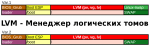
Hard drive partitioning diagram

The diagram is shown for a computer with Legacy BIOS or UEFI, but the hard drive has a GPT partition table.

Partition Primary or Logical Size Mount Point Description
biosgrub Primary 1MB Reserve BIOS Boot partition. BIOSgrub flag
boot Primary 1000MB /boot System partition for installing the Grub bootloader and Linux Kernels
var Logical 24GB /var System partition for storing auxiliary program files and logs
root Logical 24GB / System root partition
home Logical 24GB /home Partition for user home directories
swap Logical 4GB Swap file (size equal to RAM)
boot efi Logical 500MB /boot/efi System partition for the EFI shell, required for installing Linux Mint. Flags: boot, esp

Clarifications:

  • The /var partition was placed before the root / to ensure higher performance (access speed) of the hard drive. Since when using an HDD, files at the beginning of the disk are read at a higher speed.
  • I divided the / and /var directories into different sections so that the “root” would not overflow from too large a volume of /var.
  • The size of the /var partition, in my experience, is 24 GB, because... during long-term (several years) work on a PC, the size of the /var folder, taking into account the snap applications and the mysql database, is 17GB.
  • The efi partition with mount point /boot/efi installed automatically by the Linux Mint installer. The file system of the efi partition is fat32. The "efi" section flags are boot and esp.
  • The order of the logical partitions is not important. For example, the following is possible: biosgrub, boot, efi, var, root, home, swap.

Operating system installation

Before installation, be sure to check the media checksum:

md5sum /dev/cd-rom

or

sha256sum /dev/cdrom

and check it against the reference checksum in the corresponding file on the web server from where you downloaded the ISO image.

Then boot from the removable Live media and install the OS.

For installation, it is advisable to connect to the Internet, because In addition to DVD-R, newer versions of files from Linux Mint repository servers are used.

Result

Booting the computer from a GPT hard drive after installing Linux Mint on it with the specified scheme was successful.

Hard disk space usage after installation

Partition Main or logical Mount point Size Free, MB
biosgrub Primary 1 MB 0
boot Primary /boot 1 GB 0.8 GB
var Logical /var 24 GB 22 GB
root Logical / 24 FB 14 GB
home Logical /home 24 GB 22 GB
swap Logical 4 GB 0
boot efi Logical /boot/efi 500 MB 493 MB

In this option, the root “/” has 14 GB free, but when using the OS, this free space will not decrease unless additional software packages are installed. Only the /var partition, which stores changeable program data and logs, will grow. This protects the root "/" from overflowing and the PC from freezing. Likewise, running out of space in /home will not affect the root "/". Because if the free space in the “root” of the disk runs out, the operating system refuses to boot.
User data ("home directory") is written to a separate partition, which is mounted in /home, which simplifies OS reinstallation and backup.
Having 2.5 GB of unallocated space at the end of the disk is not a big problem because... at the end, the access speed usually drops and problems with reading data occur more often.


Hard disk partition table information:

sudo fdisk /dev/sda

Command (m for reference):p

Disk /dev/sda: 74.53 GiB, 80026361856 bytes, 156301488 sectors
Disk model: SAMSUNG HD080HJ

Units: 1 sectors * 512 = 512 bytes
Sector size (logical/physical): 512 bytes / 512 bytes
I/O size (minimum/optimal): 512 bytes / 512 bytes
Disk label type: gpt
Disk ID: 44D70CAE-3EC8-4ABD-9B2C-2104FEF67BFA

Device Start End Sectors Size Type
/dev/sda1 2048 4095 2048 1M BIOS boot
/dev/sda2 4096 1957887 1953792 954M Linux file system
/dev/sda3 1957888 48832511 46874624 22.4G Linux file system
/dev/sda4 48832512 95754239 46921728 22.4G Linux file system
/dev/sda5 95754240 142628863 46874624 22.4G Linux file system
/dev/sda6 142628864 150441983 7813120 3.7G Linux swap
/dev/sda7 150441984 151418879 976896 477M EFI


Related publications