26
March
2021
Radio -beacon RB1CA in Priozersk
13:49

Radio -beacon RB1CA in Priozersk

26 March 2021 13:49

On the air of St. Petersburg and the Leningrad Region for a long time, there were no OHV lighthouses of ranges of 144 and 432 MHz.
What made it difficult to determine the tropospheric passage. But in 2021 the situation changed.

In February 2021, in the city of Priozersk in the north of the Karelian Isthmus, a lighthouse with a call sign of RB1CA, a capacity of 5 watts at a frequency 144420 kHz was included.
Observing the signal level of which can be concluded about improving refraction, that is, envelope with radio waves of the horizon. With increased refraction, the so -called “passage” is observed - the far tropospheric distribution of radio waves, with which radio amateurs carry out radio communications on VHF with correspondents that are beyond the horizon.

The verse signal rb1ca , author and owner Boris UA1CCCB is assigned the lighthouse. The transmitter is registered in Roskomnadzor (Federal Service for Supervision of Communications, Information Technologies and Mass Communications).
Installation height - 24 meters above sea level and 35 above the ground, square Qth Locator - KP51BA.

What is the exact installation location at the RB1CA lighthouse?

The lighthouse is installed on the mast of the radio broadcast tower. The radio machine for the FM radio station are in Priozersk, but its position could not be established. The lighthouse is located somewhere in the square KP51BA 😁
P.riozersk maP.

Lighthouse Work recording RB1CA

РадIOOOAK works alternately in three modes, one of which is gaining popularity machine-generated mode (MGM) called PI4. This mode is interesting in that it allows you to receive a signal with a low signal/noise attitude. I wanted to establish the fact of the lighthouse work and write it in the WAV / MP3 format and, if possible, photograph the antenna.

On a day off, Saturday, March 13, 2021, he went to Priozersk. I propose a trip report and a small study on the CW / Pi4 Beacon.

The recording of the RB1CA lighthouse at 144.420 MHz is made using the RTL -SDR receiver (Tuner FC00013 is not the best replacement of the R820T) and a laptop with a program SDR# версии 1700.

Sound

The working transmission cycle is 100% and is cyclically repeated every minute. The transfer consists of 3 parts:

  • Pi4 modulation 25 seconds long,
  • call sign with a Qth-Locator last 15 seconds
  • Unmalded bearing - 20 seconds.

Digital PI4 mode on "Waterfall"

Pi4 RX SDR WatefaLL

The PI4 signal consists of 4 tones.
The decoding of characters is given in Description of the PI4 mode (PDF).

Setting a receiver on a radio beacon

The radio station should be tuned 800 Hz below the frequency of the lighthouse. That is, if the frequency is 144820.00 kHz, you need to tune at 144819.200 in USB mode. Setting in USB mode can be done by ear (when the tone of the lighthouse approximately corresponds to the tone of the telegraph_ 800 Hz). The minimum accuracy of the frequency settings is ± 50 Hz.

For a more accurate setup, which compensates for the deviation of the frequency of the transversal generator, you can use the “zero beats” method (the term “zero beats” means tuning with a tone of 0 Hz).

  1. Turn on the CW mode,
  2. Disconnect the electronic key (KEY) and transmission mode (BK).
  3. Press the key. A continuous tonal signal will be heard with the tone frequency of 800 Hz (the frequency of tone is set in the transceiver menu).
  4. Tail closely from the frequency of 144.820, and by the rotation of the handle of the frequency adjustment handle to the coincidence of the tone of the lighthouse and the frequency of the tonal generator.
  5. With an accurate coincidence of two frequencies, it will not be noticeable by the ear of the beats, so the adjustment of the frequency of the transceiver is completed.
  6. Also, in the FT-857/FT-897, with accurate frequency tuning in CW mode, the blue LED in the upper part of the front panel begins to burn.

If a receiver (not a transceiver) is used, you can use a sample of tone 800 Hz, starting its playback, for example, on a smartphone. Sinusoidal signal with a frequency of 800 Hz is given below.

Decoding Pi4

For decoding, there are programs for Windows Pi4rx или MSHV.

rc1ba

For low levels of admission and maximum levels of "Signal/noise", time synchronization is also needed - using the NTP client Net Time, or built -in in Windows, after forced synchronization of time with the time server on the Internet, such as ru.pool.ntp.orG .

Lighthouse range

If you move on a car along the A -121 “Sortaval” highway towards Priozersk, the noise -quotant begins to open at a turn on Sosnovo - a distance of 55 km to Priozersk. Then the signal disappears and appears again. He reaches maximum strength at the entrance to Priozersk, in the area of ​​the bridge across the Vuoksa River.

karta_google

It should be noted that the polarization of the antenna of the transmitter and receiver differs - it is horizontal in the lighthouse, and in the automotive antenna is vertical. Therefore, when using the antennas of horizontal polarization, the range can be larger.

Lighthouse coating card calculation

In the program radio Mobile рассчитал трассы для приема маяка. С обоих сторон выбраны антенны с усилением 7 dbi, ненаправленные (OmNi). The height of the installation of the lighthouse antenna is taken into account when calculating. The height of the receiving antenna took 2 meters - a low mast for transportation in the trunk of a car.

  1. For conventional distribution conditions (lack of tropo) - 95% of the time - 346 days a year.
    Coating card 95% of time

  2. For improved tropospheric passage (the presence of a weak tropo) - 33% of the time - 120 days a year.
    Coating card 33% of time

The calculation of the RB1CA coating cards is made for horizontal polarization in conditional S-Balls of the signal level. In addition to the terrain, vegetation is introduced in the program, in addition to the terrain, and a moderate-content climate is set.

The most profitable QTH for the reception of a lighthouse

Completed several calculations of the tracks for the surroundings of St. Petersburg for good passing conditions (the probability of taking 70% of the season).

  1. Railway station Orekhovo
    Orehovo
    Signal/noise 18 dB.

  2. Big Izhora on the southern coast of the Gulf of Finland (on the mountain h = 15 meters)
    b_izhora
    Signal/noise 5 dB.

  3. St. Petersburg from the roof of a 9-storey building (h = 20 meters), there are no local obstacles.
    SPB
    Signal/noise 7 dB.

  4. S-Petersburg from the square KO96cu from the ground
    Piter
    Signal/noise 0 dB.

  5. Mountain near the village of Kaporskoye, near Annino (h = 100m).
    kapor2
    Signal/noise 10 dB.

In the absence of passage (i.e., the probability of taking 98% of the time) the signal strength is much worse - 0 points in St. Petersburg. For example, with precipitation and cyclone, very wind. In such weather conditions, the reception is guaranteed no further than Orekhovo - Sosnovo (at a distance of 55-60 km from the transmitter). In the case of a higher sensitivity of the receiver (a low -soured amplifier near the antenna - LNA) and antenna grates from Yaga antennas 5-8 meters long, the reception range increases, but much depends on the terrain in the direction to the north.

Summary table v.

C.allsign QTH Loc. FrEQ AZ ODX, km
rb1ca Kp51ba 144.433 356 116
oh7vhf Kp32tv 144.433 4 278
oh2vh KP20MH 144.470 277 280
SK4mpi Jp70pi (aurora beaCon) 144.412 280, 330 (A) 829, 2000 (A)
oh2uhf KP20BB 432.443 274 342
oh6uhf Kp13gm 432.840 317 566
oh2shf KP20BB 1296.928 274 342
oh3shf Kp11tm 1296.850 298 400
oh9shf Kp36oi 1296.945 349 725

Azimuts and distances are given relative to the center of St. Petersburg, KO59DX.

Location, power and strengthening of radio antennas

C.allsign QTH Freq. Power Antenna Mode
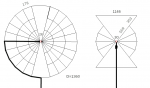
rb1ca Priozersk, Russia 144.433 5 w 6 dbd @ az: 130 ° Pi4/CW
OH7VHF Tuupovaara, Восточная Финляндия 144.433 50 W 4dbd PI4/CW
Oh2vh Helsinki / Vantaa, South Finland 144.470 1 w 0 dbd CW
SK4mpi Borlänge, Швеция 144.412 100 W 7 dbd + 7 dbd; Az: 50° + 310° PI4/CW
Oh2uhf Inkoo (ING), Western Finland 432.840 250 W CW 8 dbd CW
OH2SHF Inkoo Rådkila, South Finland 1296.928 50 W CW 8 dbd CW
OH3SHF Tampere, Центральная Финляндия 1296.850 50 W 4 dbd PI4/CW
OH9SHF ROVaniemi PirttikoskI, server Finland 1296.945 30 w 10 dbd CW

In all lighthouses, the polarization of radio waves is horizontal.


Useful links:
https: // ua1zfgsite.wordpress.com/pi4-mode/
https: //automatic.sral.fi/index.php?p=list&stype=beacon&repstaTUS = QRV
https: // cubesat.hammania.net/
http: // forum.vhfdx.ru/mayaki/majak-rb1ca-(beacon-pi4cwcarrier)-na-144-420-mgc/

Last change: 04/22/2025


Related publications