30
December
2021
Constructive solution of the power unit of the antennas "Uda-Yagi" on VHF range with a split vibrator
15:58

Constructive solution of the power unit of the antennas "Uda-Yagi" on VHF range with a split vibrator

30 December 2021 15:58

In amateur designs of the antennas of the VHF range, a split half -wave vibrator is often used. The manufacture of the power supply units raises questions.

The advantage of a split vibrator is that it does not require special devices or locksmith skills. We need only a hacksaw for metal, a file, a powerful screwdriver, pliers, screws, nuts of the M4 and M5 washer, a piece of plastic plastic plates for the manufacture of a central insulator and an anodized aluminum 1 meter with a diameter of 8 mm.

I usually buy all parts for manufacture in the Maxidom construction product store. Plastic is suitable from a cutting board for products (from 75 rubles = ~ $ 1).

First, you need to make a plate with dimensions of 16 by 8 cm. If there is an electrolobian, we use it.
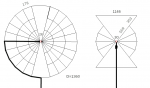
ЗатEm, retreating from the edges of 2cm make 6 holes along the axes of symmetry. The pipes of the halves of the vibrator are attached to the plate using exhaust rivets. The supply unit assembly is attached using screws to the square of a square section of 20 x 20. Connect the cable through the petals and the M4 or M3 screw with washers, with the puck of a grover and a nut (or use a self -ending nut with a polyethylene sleeve, a puck is not needed).

The questions are of interest, which are not ill with:

Question 1) What should be the air gap between the ends of the tubes in the power node?
OTE 1) The minimum distance is determined by the spark interval and breakdowns in the dielectric. As you know, on halves of the diploma, charges of various signs are summed up using the generator - plus and minus, which changes to the opposite for half the period of oscillations. If you discard the probability of a discharge through the air (because the air has a high breakdown voltage: 4 kV with a gap of 1 mm and 800 V at 0.1mm), and take into account only the Chate charges on the humid surface between the terminals in the central part of the dipole - the voltage up to 20 centimeters at a distance of 2 centimeters (10 centimeters), in the worst case - in the worst fit Electrodes to dielectric (source - V.V. Soloviev - isolation of electrical installations, a textbook, Blagoveshchensk, AMGU publishing house 2014).

The resistance of fresh water from precipitation is 10 μs/meter or 100 koms/meter or 1 kOhm per 1 cm. However, the aluminum surface is anodized, the power points should be protected from atmospheric precipitation - sealant, varnish, plasticine, placement, placing the power supply inside the mounting box , which will protect against the formation of a continuous water filler filler and between the "electrodes".

The power was considered by the formulas:

P = u x i
I = u / r
P = u x u / r
R = 50 Ohm

for direct current:

Air gap, mm Pierced tension, volt Output power max, kW
1 1000 20
5 5000 500
10 10,000 2000

For alternating current 1-300 MHz, select a voltage of 1-6 kW per centimeter
(For alternating high frequency voltage, the gap should be larger due to various effects in the dielectric-heating due to the voltage, the formation of conductivity channels, the aging of the material, the formation of arc discharges, etc.).

for alternating current of high frequency:

Air gap, mm Pierced tension, volt Output power max, kW
1 100 0.2
5 500 5
10 1000 20

We can say that for the maximum permitted power of 100 watts, any gap from 1 to 20 millimeters is suitable for VHF. They choose it from constructive considerations: when connecting the coaxial cable, the power points should not be too far from each other, and the conclusions of the cable should be as short as possible (for example, in Ethernet conclusions outside the cable are allowed within 20 mm). With a gap of 5-10 mm and a slope from the edges of 1 cm, the distance between the power points will be 25-35 mm, which is quite convenient for installation and does not cause large parasitic reactivity. A gap equal to the diameter of the tube 8 mm is required. For constructive reasons, you can increase it to 10 mm.

Question 2) Is the food acceptable not to the edge of the tubes, but with an indent to the edges, for example, 4 cm from the center ?
Outlet 2: acceptable. Explanation using modeling:
Feeding

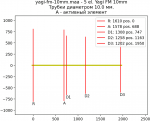
The initial antenna (ideal power of the split dipole in the edges of the tubes. Gap 10 mm): KSV = 1.01
(Z = 50 Ohm + J0).

When powering not with the edge of the tubes (the distance between the power points is 20mm): KSV = 1.13 without configuration
(Z = 50 Ohm +J6).

When powering not from the edge of the tubes (the distance between the power points 30mm) kSV = 1.2 without tuning
(Z = 50 Ohm +J9). After setting up by a change in the length of the dipole KSV = 1.1 (Z = 47 Ohm + J0)

An alternative method of configuration: not a change in the length of the dipole, but the last director:
KSV = 1.01 - I had to move the distant director and change its size.

The initial value of 4 directors

  • length 0.877
  • Position 0.994

The configuration of the antenna is reduced to a gradual decrease in the size of the dipole with a file, with the control of the KSV.

Thus, the displacement of the frequency of the antenna settings is achieved until it stands into the center of the required range - 144.3, 145 or 145.5 MHz. The most distant director can be moved in multi -element antennas.

Since the 4-element antenna was taken, after setting up 4 directors

  • length 0.867 (became less by 10 mm)
  • Position 1.055 (displacement along the traverse further by 61 mm).

Thus, an increase in the distance between the power points leads to the formation of reactivity of a positive sign (inductance) and increases the KSV to 1.2.

For configuration, it is advisable to make a supply of 70-80 mm on the far end of the traverse to move the last director to the edge,
at the same time, you can achieve KSV 1.1-1.0 without a deterioration in the orientation diagram.


Directors are mounted in the same way as in a split vibrator - using insulating sites and rivets. Only the sizes of the sites can be taken less, because The loads on the elements are weaker than the dipole. Also, it is possible to install elements through the traverse, provided that the tubes are insulated from it (isolated elements, for example, to the tubes in the tube in the heat -musted tube (“heat -ousse”). The most advantageous option is not all of the 3D printer are available to everyone.


Related publications