10
October
2025
Memo. Procedure for the death of a relative from illness
17:38

Memo. Procedure for the death of a relative from illness

10 October 2025 17:38

After my mother’s death, I decided to write a guide, while I still remember the sequence of actions during a funeral.

Introduction: u moms with an upper pressure of 180, a stroke occurred and she was taken to the hospital. There she spent two weeks on mechanical ventilation (ALV) and died on Friday. Friday is a bad day in many ways. In this case, the pathology department works until 15:00 and it was not possible to obtain a medical certificate about the cause of death, without which a death certificate cannot be issued. The morgue is closed on Saturday and Sunday.

In the article I indicated the sequence of actions for a funeral “at your own expense.” Prices are approximate and are given for October 2025, they may change taking into account inflation.

For “social” funerals, prices are significantly lower. See end of article.

Day 1. EMERGENCY HOSPITALIZATION

Day 1. PART 1. AT HOME

1) before the arrival of emergency medical care, you are obliged to provide first aid (in accordance with parts 1 and 4 of Article 31 of the Federal Law of November 21, 2011 N 323-FZ “On the fundamentals of protecting the health of citizens in the Russian Federation”) - Appendix No. 2 shows first aid measures .

2) Call an ambulance by calling 112 or 03. The medical team will arrive no later than 20 minutes from the moment of the call. When receiving a call by phone, the operator will ask you to give your age and symptoms, address (including entrance) and contact number, and your details, which takes a few precious minutes.

3) before the ambulance arrives, find the patient’s documents:

  • Russian Federation passport
  • Compulsory or voluntary health insurance policy (compulsory medical insurance policy)
  • SNILS

and things:

  • underwear (T-shirt, panties, socks);
  • clothing that the patient will wear in the ward (tracksuit, etc.)
  • clothing for moving around the body (jacket), rubber slippers
  • personal hygiene products
  • medicines.

3) in the dark, if there are several people in the house with the patient, one of them should go downstairs, illuminate the entrance with a flashlight for the ambulance driver, let him in through the intercom and escort the medical team to the apartment.

4) the doctor and his team will examine the patient and provide qualified emergency medical care, in accordance with Art. 35 Law No. 323-FZ of November 21, 2011 (latest edition). Most likely it will be offered emergency hospitalization sick to the nearest hospital by ground transport, that is, emergency transportation.

5) If the patient is conscious and signs documents:

*service agreement*
permission for medication intervention**

If not conscious or in a clouded state, one of the relatives signs (I don’t remember exactly).

6) The patient’s Russian passport and signed documents are taken by a team of doctors who take the patient to the hospital’s emergency room. These documents - Passport, Compulsory Medical Insurance Certificate, together with the patient's clothing will be stored in the reception room.

There is an option: not to give your passport, compulsory medical insurance and SNILS to the medical team. If the Russian Federation passport is kept by relatives, then in the event of the patient’s death there is no need to contact the deputy head of the hospital with an application for its issuance. In my case, the deputy manager left for lunch and the application for receiving documents could not be submitted promptly, which is why the Russian Federation passport continued to lie in the Reception Room (and it is needed to issue a Death Certificate) until Monday.

7) if a person cannot go down to the ambulance with his own feet, go around the neighbors in the entrance, and if they are not there, find several (3) strong men on the street, because female ambulance doctors cannot transport a stretcher due to their build.

8) the head of the ambulance team will verbally inform the relatives of the hospital where the patient will be taken. For example, hospital No. 15.

9) do not forget to transfer the additional things specified in paragraph 3 in the package, signed by the patient’s full name.

10) in general, it is advisable to travel with them in the same ambulance, that is, with a team of doctors, since it is not known what happened inside (vomiting and entry of vomit into the lungs - aspiration, for example). To do this, the patient must lie on his side, but this is not observed.

Day 1. PART 2. Emergency room.

1) in the emergency room, the patient is taken from office to office for research -computed tomography, X-ray, etc. At the end they bring him back to the very first room, where he lies and groans. The waiting time can range from tens of minutes to several hours. There is no oxygen in the emergency room. It is necessary to support the patient so that he does not fall off the couch.

2) As a result, the patient is taken to one of the departments: cardiological or neurological or therapeutic. Here you can get into a local delivery car and drive through if the hospital consists of several buildings. After which, the patient is taken somewhere outside the door and you don’t see him anymore.

3) Talk with the doctor. A doctor may come out and talk about the reasons (history taking).

The day is over.

Day 2.

1) Go to the hospital help desk and find out the patient’s condition and in which department he is registered in the database (you need to provide your full name and date of birth).

2) Go to the department and find out the time at which the doctor comes out to talk with relatives - since the security guard and electronic lock do not allow entry into the department, you can only stand in the corridor at the entrance.

3) You can immediately take the following accessories with you and put them in a new plastic bag:

  • clean, non-carbonated water in a bottle (you can buy it at the grocery store or in the same vending machine that sells snacks),

  • sheets for bedridden patients (buy at a pharmacy),

  • diapers ("pampers") for adults (sizes S, X, XL - you need to know the person's waist size in advance - you can order through Ozon or buy at a pharmacy).

ЧерUsing a special marker, write on the package of sheets, diapers and water, as well as the package: for example, department No. 9, last name. Place the tied bag in a cart, as in a supermarket (it is taken out for the patients' relatives by a security guard at about 2:30 p.m. If there is no cart, you can transfer things to the department through a security guard).

Day 3 - Day N

1) Take time off from work and come to a meeting with a doctor at the department at the appointed time for everyone. Usually he goes out into the corridor and talks with relatives sometimes for a long time, so it is advisable to take a turn.

2) Tell the doctor your contact number, he will write it down on a sheet of paper with a printout about the condition of the patients in his department.

3) After about a day, have water, diapers and sheets in a bag with your full name written on it. If required.

4) With the permission of the head of the department, you can go to a person who is seriously ill or near death. During the entire period, you can see a relative 1 or 2 times. If a refusal follows, you can contact the deputy chief physician (in the administrative building). At the same time, the admission of a priest for confession and communion is also through the deputy chief physician.


Actions on the day of death

In the hospital

It should be noted that doctors’ diagnoses may change from the first day to the last, with a gradual deterioration in the prognosis (temporary positive changes are usually to reassure relatives and you need to prepare mentally for the loss).
Moreover, treatment is a “black box” for the uninitiated. The result is either recovery or death. If you are on a ventilator for more than 3 days, your kidneys may begin to deteriorate and blood circulation in your legs may stop (thrombosis). It all ends with MOF - multiple organ failure, i.e. terminal stage. Everything is in the hands of the Creator and thank God for everything!

On the day of departure from this life, or the next day, you need to obtain a MEDICAL CERTIFICATE OF DEATH as quickly as possible.

1) If death occurs, and this happens with seriously ill patients,informing: a call will be received to the contact phone number specified in the voluntary consent in the documentation from an unknown number.

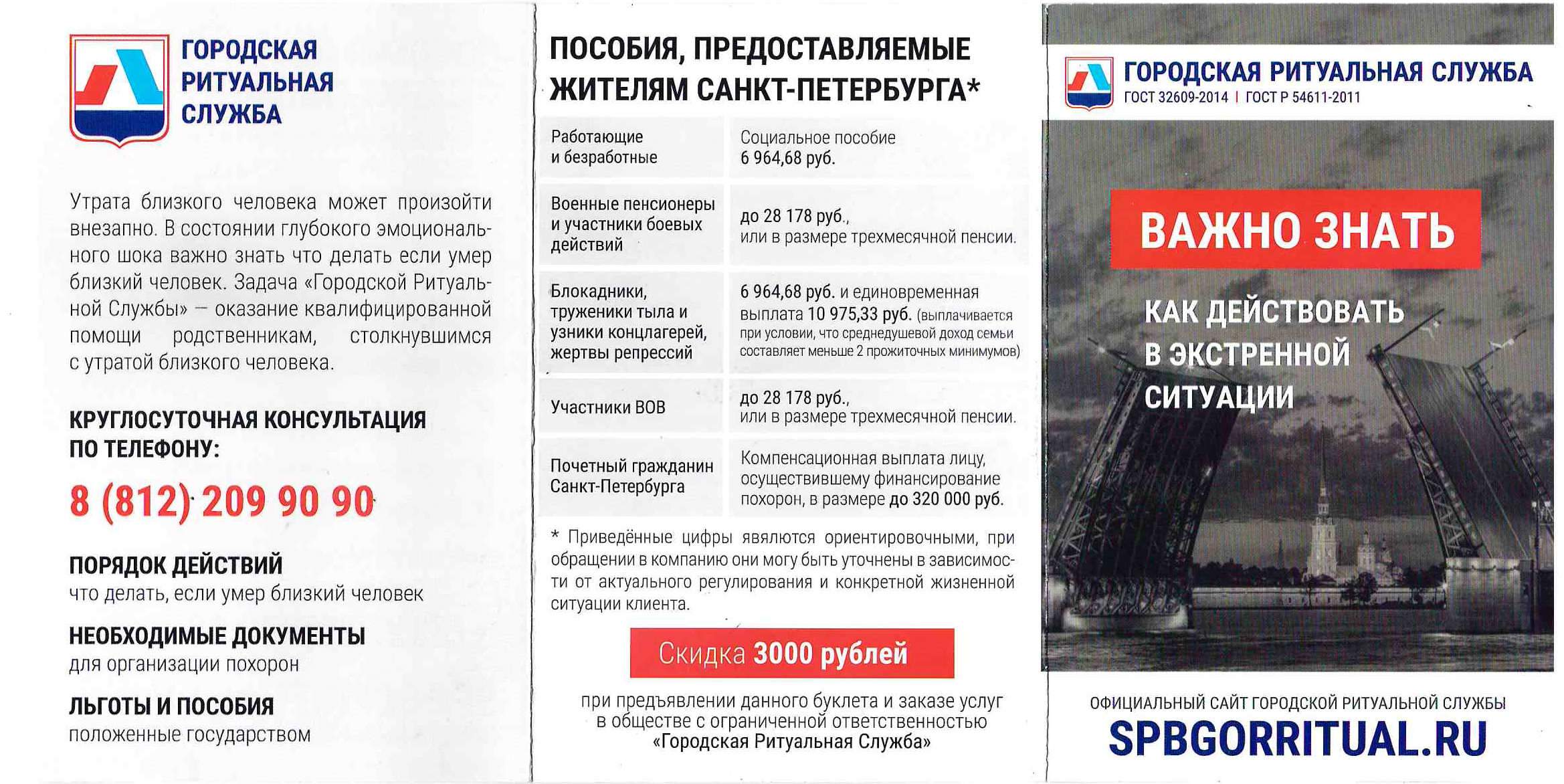
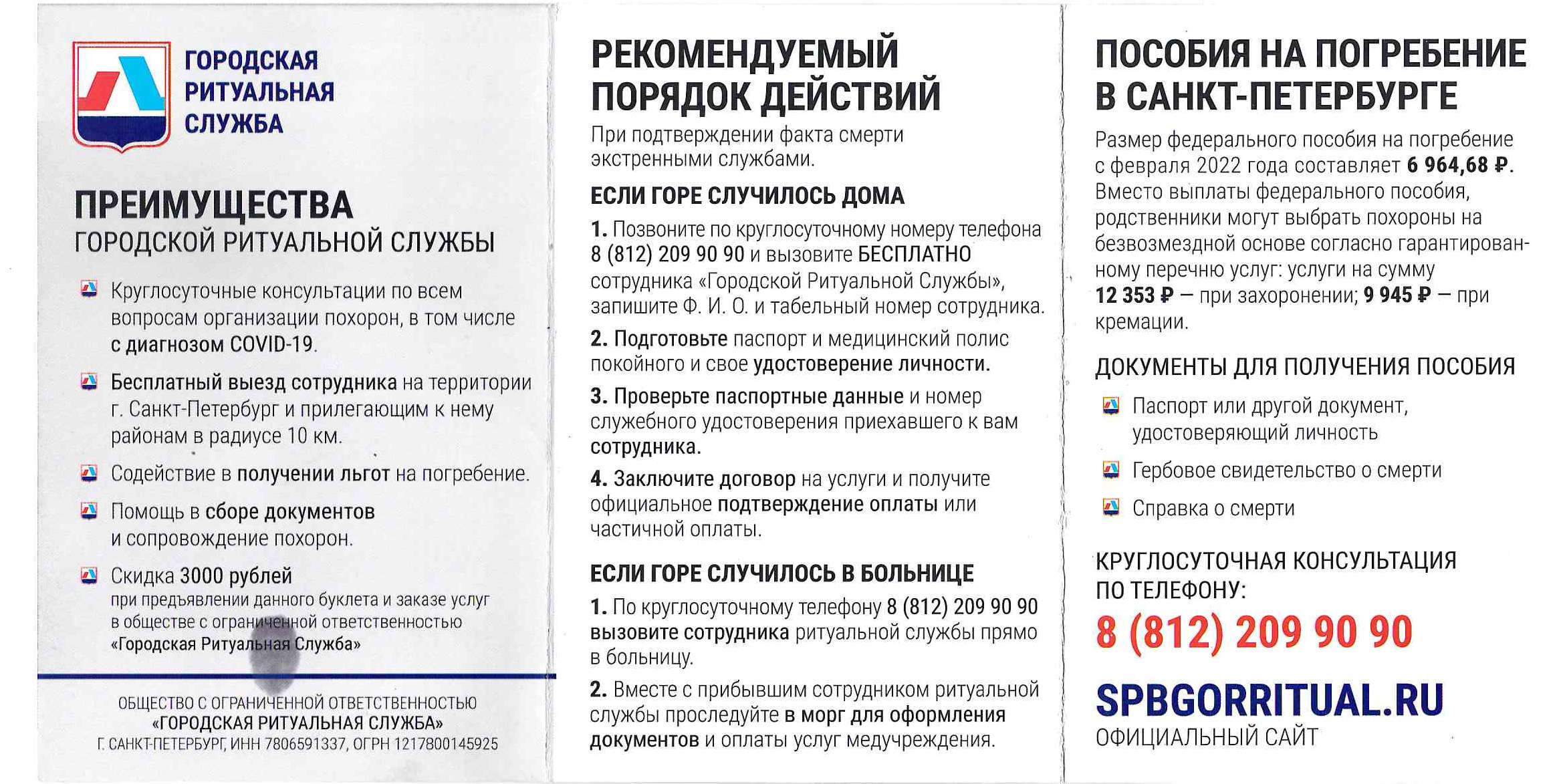
2) Exists City funeral service(GOST 32609-2014, GOST R 54611-2011). Her phone number is in St. Petersburg +7 (812) 209-90-90.

  • 24-hour consultations on funeral arrangements.
  • Free call to a service employee in the territory of St. Petersburg and surrounding areas within a radius of 10 km.
  • Assistance in collecting documents and accompanying funerals.

In my case, I received a call from this service, they asked me if I understood everything about how to conduct a funeral. He replied that no help was needed. At the same time, my mother’s sister and I took on the responsibility of obtaining documents (we did not hire an agent).

It should be noted that the cheapest method of funeral is at the expense of the state.

You will also receive a call from the registry office agent, where they issue a death certificate. In my case it was Diana Alexandrovna.

3) If you decide to have a funeral or cremation on your own without the participation of the City Funeral Service, the path is described below. The price of this option based on experience 116,000 rubles for October 2025.

4) First of all, you need to come to the hospital and go to the morgue, where near the office there is a printed exact procedure with a list of all documents. Here is a retelling of what has been established for Hospital No. 15 in St. Petersburg.

5) Come to the administrative building from 11:00 to 15:00 at the reception of the deputy chief physician. Have with you:

*documents confirming relationship: marriage certificate (for spouses) or birth certificate (for children),

*Your identity document (Russian passport).

6) In the administrative building you must fill out application for documents and things of the deceased from the Reception Room: receive resolution on issuing documents from the deputy chief physician. Lunch break in the work of the Deputy Chief Physician from 13:00 to 14:00.

7) In the paid services building (opposite the administrative) pay for paid services of the State Hospital:

  • Preparation before dressing the body of the deceased - 1600 rubles.
  • Dressing the body of the deceased (deceased) - 1000 rubles.
  • Work with the body of the deceased (deceased) - 600 rubles.
  • Layout of ritual accessories - 200 rubles.
    Total:3400 rubles for orderlies in the department where the patient died are paid through the Paid Services Corps.

They will give you 2 copies of the invoice. The copy without the QR code will be given to the morgue when the body is released.

8) A copy of the application must first be submitted to the Infectious Diseases Corps(at the end of the hospital) from 11 to 12 noon. In the infectious disease building on the second floor there is a cloakroom, put on shoe covers. You either documents of the deceased will be issued, or they will send you to the Reception room, if the documents are there. As for the medical history, it should be transferred to the Pathology Department through their own channels. They don't give you your medical history. Pathologists do not perform an autopsy without a medical history, and they do not work on weekends.

9) B Emergency room(at the beginning of the hospital) we receive the documents of the deceased and be sure to sign for their receipt.

10) With the documents of the deceased from 10:00 to 15:00 on weekdays, you must contact Pathology Department. It is located at the hospital morgue - a separate building to the left of the church. There may be a queue at the office on the second floor of this department, so we are the first to occupy it at half past nine.

In order for a death certificate to be issued, the following conditions must be met simultaneously:

a) receipt of the medical history of the deceased from the department to the morgue,
b) have in hand the Russian Federation passport of the deceased,
c) receipt of corpse (body),
d) working day of pathologists. The main problem with the latter is that the autopsy takes place in turns, and the working day of pathologists is limited: up to 14 hours.
e) an autopsy has been performed.

11) If there was no autopsy, wait for it to be performed (this can happen the next day or every other day, or two days later if it’s a weekend) and get MEDICAL CERTIFICATE OF DEATH("Medical death certificate") in the Mortuary Office from 11:00 to 15:00 on the second floor. There is a long line in front of the office, there are free shoe covers (they run out in the evening). This certificate indicates the cause of death - for example, “Cerebral edema.”

12)Call the cemetery chosen by relatives. The administrator-caretaker will inform you whether burial is possible. And he will provide the phone number and address of the funeral home of this cemetery. We will go there after the farewell and funeral service to pay for burial services.

To the registry office for issuing DEATH CERTIFICATES

1) having in your hands a Medical Certificate of Death, your Russian Federation passport and a document confirming your relationship, come to the city Department of Civil Registry of Deaths(registry office about death). There are two of them in St. Petersburg, you can come, whichever is closer:
*St. Petersburg, Dostoevsky street, building 9*
Peterhof city, Torgovaya Square, building 6**

2) in the registry office there is an electronic queue about death. They call twice - to submit documents and to issue documents.

You need to submit 3 main documents at the window:

  • passport of the deceased
  • applicant's passport
  • medical certificate of death issued by the pathology department of the hospital,

Additional documents:

  • birth certificate of the deceased (if available)
  • the applicant’s birth certificate (if the deceased was his parent), marriage documents (for the spouse), confirming the relationship.

As a result, the registry office will register the measurement in the state database and give it to you two documents:

  • Death certificate with official seal” on a special form. Simply put, this is a real [b]DEATH CERTIFICATE[/b].
  • Form No. 11 (previously form No. 33) - “Death Certificate No.” on a plain A4 sheet. In the death certificate, in addition to the full name. the deceased, dates of birth from death, place of death, causes of death and chronic diseases contributing to death are indicated in small print, date of the document and name of the authority that issued the certificate, signature of the originator.

!"Death Certificate"(stamp) perpetuates the death of the deceased and serves as a kind of passport for the deceased. It is also needed to perform a number of procedures related to funerals: to reserve a place in an open cemetery, when registering a related subburial, to order cremation services, when placing an order for a ritual service, i.e., Form BO-13, to ensure insurance payment if ritual insurance was issued, when organizing the transportation of a body to a remote burial place (cargo 200), to carry out exhumation with subsequent reburial.Source: RITUAL.RF

!"Death Certificate" needed for a free (social) funeral at the expense of the state (Source: RITUAL.RF), informing banks and other financial organizations about the termination of banking service agreements, termination of utility service agreements, closure of an agreement with a cellular operator and Internet provider, to begin the procedure for dividing an inheritance in a notary office (“opening an inheritance case”) and to receive financial assistance at work, re-registering a social rental agreement for premises for relatives of the deceased, terminating rental agreements, etc.Source: Ritual-78.ru

3) without going far, go to a funeral shop that sells coffins. I chose a salon on Dostoevsky 24/9 (“Close People”), where to order

  • coffin - the most inexpensive 15,500 rubles. (maximum 50,000 rubles)
  • pillow and bedspread (shroud) - 3200 rub.
  • white slippers in the size of the deceased’s feet (so-called “footprints”) - 500 rubles.
  • for a woman - stockings - 700 rubles.
  • wooden cross for the grave - 5,000 rubles.
  • plate with the inscription full name, dates of birth and death (on order) - 2100 rubles.
  • basket of flowers or wreath - 3600 rub. (you can put it in your car)
  • Picking up the cross at the warehouse - 2500 rubles.
  • delivery of the coffin by road to the morgue (hearse) - 3,500 rubles.
  • hearse from church to cemetery - 15,000 rubles.
    TOTAL paid to the funeral shop: 51,600 rubles.

At the same time, we inform the store manager about the time at which the body is picked up and where the cemetery for burial is located.

Total expenses on the first day: 51,600 + 3,400 rubles = 55,000 rubles.
(Previous expenses: 3,400 rubles to the orderlies of Hospital No. 15 for preparing the body).


We collect clothing for the deceased or deceased:

Men:

  • panties

  • T-shirt (t-shirt, shirt),

  • socks

  • trousers

  • jacket (sweater, jumper)

  • shoes

  • handkerchief

  • optional - tie, perfume, dentures (if worn)

  • items for sanitizing the body (sheet, towel, soap, shampoo, deodorant)

    Women:

  • panties

  • stockings (tights)

  • T-shirt (combination)

  • dress with long sleeves (skirt, blouse)

  • shoes

  • headscarf

  • handkerchief

  • optional - cosmetics, perfumes, dentures (if worn)

  • items for sanitizing the body (sheet, towel, soap, shampoo, deodorant)

Day after death

1) If the funeral is Orthodox, come to church in the morning. In a candle shop, ask a temple employee (candlemaker) to find out the date when the priest can perform the funeral service. This will be the exact date of the funeral. At the same time, the funeral service will take place after the end of the morning Liturgy, in an hour, because immediately after it, the priest must refresh himself and rest. In our case, the funeral service was scheduled for 11 am. Paid 10,000 rub. for the funeral service.

2) Go to the funeral room and negotiate with the orderlies about payment for paid services:
*orderlies: preparing the body, dressing the body, laying out the arms, makeup, laying the bedspread, etc.
Payment for work:24920 rub. orderlies.

**Preliminary result of the 2nd day: the work of the orderlies in the funeral hall, and the work of the priest: 34,920 rubles.

2) You need to find a phone number and call the caretaker of the cemetery - inform your desire to bury the deceased in this cemetery and the date of the funeral. New plot or “burial” - and the size of the plot.

3) Conclude a contract for the provision of services with FUNERAL HOME(in my case to the city of Lomonosov).

  • registration of an agreement with the bureau - 4,000 rubles.
  • for digging a grave, arranging a grave for a funeral (spruce branches, fabric), the work of a team of 2 people - 20,000 rubles.
    TOTAL funeral home: 24,000 rubles.

Total expenses for the 2nd day: 24920+10000+24000 = 58920 rub.

5) Make an appointment by phone with the cemetery caretaker and come to the cemetery. Having a contract in hand. He will offer a place for a grave. We choose a place for the grave and confirm that it is possible to dig a grave in this place. And let me know exact time when the hearse arrives. By this time there will be a team of workers to place the coffin in the grave and bury it

Preliminary TOTAL: 51,600 rub. (items for funeral) + 24,000 rub. (cemetery) = 75,600 rubles..

(In the same place, you can immediately discuss the arrangement of the grave with the caretaker of the cemetery after the funeral.

  • concreting a place and a fence or corners - 150,000 rubles
  • for the next season (summer) the monument - 200,000 rubles).

6)Required report manager store**(in my case - “Close People”, Ekaterina +7966 927 9353), in which they bought funeral supplies, which at the cemetery successfully agreed on burial.

  • THINGS: name what time of day and where the car with accessories (an ordinary Gazelle) will arrive at the morgue 24 hours before the funeral service. !!! Delivery of the coffin, “bed” pillow and slippers must take place on the eve of the funeral.
  • COFFIN: on the day of the funeral they will be taken to the cemetery - name the time at which the hearse (Ford Transit) will arrive at the morgue. The funeral service takes about 30-40 minutes, i.e. If farewell is at 10:45, funeral service from 11:00 to 11:45, loading of the body at 11:45-12:00, arrival at the cemetery at 12:45. The hearse should be at the morgue at 11:45.
  • CROSS: remind you to put a cross with a sign in the hearse.

7) inform relatives and friends of the date and time of the funeral via SMS or instant messengers.

8) buy a funeral service kit from the church:

  • a piece of paper with the text of the prayer of permission, which will be read by the priest, from which the ribbon on the forehead is cut off - the aureole
  • white handkerchief for women with the image of a cross (tradition).

9) in advance at the candle shop we buy candles according to the number of participants and SET for funeral service(a sheet with the text of the prayer of absolution, from which a strip of paper is cut off for the forehead) and a handkerchief.

The day before the funeral

1) In the morning from 10 to 13, come to the morgue and bring:

Things for the orderlies

  • clothes (pants, T-shirt, dress, jacket, headscarf, add slippers, stockings, sheets, towel, soap, shampoo, deodorant)
  • funeral service set with written name,
  • handkerchief,
  • pectoral cross (if not worn). On the bag with things there is an inscription: Full name..

2)Fee 2000 rub. morgue orderlies for carrying the body from the farewell hall to the church and from the church to the hearse.

Body preparation begins smoothly one day before the funeral.

Since the orderlies received clothes, a kit and a scarf, and at 11-12 o’clock they bring the coffin, they have everything they need to prepare the deceased.

TOTAL cost of funeral: 55000 + 58920 + 2000 =RUB 115,920.

3) Just in case, write an SMS to the manager of the salon where you ordered the cross with the coffin, so that they don’t forget to put it in hearse cross with a sign from the warehouse. Hearse - a car for transporting the deceased to the cemetery, has 1 passenger seat.

Funeral day

1) Buy bread and sausage, water at the grocery store. Cut sandwiches! Place groceries in your car in 2-3 bags or boxes.

2) Don’t forget to pick it up from home to church icon of the Blessed Virgin Mary, our intercessor.

(Her icon will be placed on the chest of the deceased at the beginning of the funeral service).

3) Buy flowers at a flower salon. Red carnations, 10 pieces and 2 burgundy chrysanthemums.

4) Don’t forget that you have a wreath for the grave in your car.

5) Arrive at the morgue at the appointed farewell time. The deceased must be dressed and lie in a hump in the farewell hall. There is a corolla on the forehead. About 15 minutes goodbye.

6) Invite the orderlies to move the body to the church hall.

7) In church, place flowers at the feet and chest of the deceased.

It is IMPOSSIBLE to perform funeral services for suicides or non-believing people or people who have been baptized but without faith. Those. against the will of the unbelievers!

8) In the church, place an icon of the Mother of God on the chest of the deceased. Distribute to relatives and light candles. The funeral service will be conducted by a priest accompanied by a choir.

9) Take flowers and an icon of the Virgin Mary from the coffin. The priest will cover his head with a shroud and pour a sand cross, and the orderlies will close the coffin and take it away.

If a person did not believe in God, immediately after the farewell hall the coffin is closed and taken to the cemetery without stopping.

10). The orderlies will load the deceased into the car, and the driver will take him to the cemetery. There are a lot of people taking goodbyes into their car at the cemetery. If you plan to have more than 4 of them, I recommend immediately ordering a hearse with seats. It is advisable that one or more people from the family travel with the coffin.

11) The hearse and your car will arrive at the cemetery with a short interval. The grave has already been dug by local workers, who were instructed by the cemetery caretaker. Workers will be waiting at the cemetery at the appointed time.

12) The funeral lasts 10-15 minutes. If the coffin is not opened, then hurry up. The workers lower the coffin with the deceased into the grave, fill the hole with earth and decorate the mound with spruce branches.

13) Thank the workers, give cash and food - sandwiches and water.

14) Set up a wreath or basket. You can stick in a few artificial flowers. Place fresh flowers on the grave.
(The workers will remove the cross, flowers and wreath when they begin to arrange the grave).

15) Funeral meal near the grave with sandwiches with doctor’s sausage.

16) Have the caretaker of the cemetery (usually he is in the house with the inscription “Administration” at the cemetery gate) put a SEAL on the back of the DEATH CERTIFICATE - burial and date. (The burial mark is necessary to obtain the right to bury relatives in the same plot next to the grave of the deceased (the right to sub-burial)).

17) Return to the city by car.


Social funeral (at the expense of the state)

According to a specialist from the registry office, “social funerals are very modest.”

ritual1
ritual2

State-guaranteed list of burial services:

  • Preparation of documents necessary for burial
  • Provision and delivery of a coffin and other items necessary for burial
  • Transportation of the body or remains of the deceased to a cemetery or crematorium
  • Burial or cremation with subsequent release of an urn with ashes

Useful links

Law on burial on the Consultant-Plus website
State service of the SFR: Payment of social benefit for funeral full name needed the deceased, date of birth, SNILS, registration address, details of the death certificate, account details for transferring funds in the bank.For more details, see sfr.gov.ru/.

!!Comment: when choosing the type of funeral (burial of the body in a coffin or cremation and burial of an urn with ashes), conducting a funeral service and receiving a funeral benefit by a relative, the will of the deceased must be taken into account. For example, if a deceased relative was a consistent opponent of registration with Gosuslugs, you should contact the SFR in person and fill out an application by hand in order to fulfill the will of the deceased: “not to mention his First Name, Last Name and Patronymic, date of birth and SNILS on the electronic portal of Gosuslugs”.

Date of last change: 10/15/2025 - comment above.